
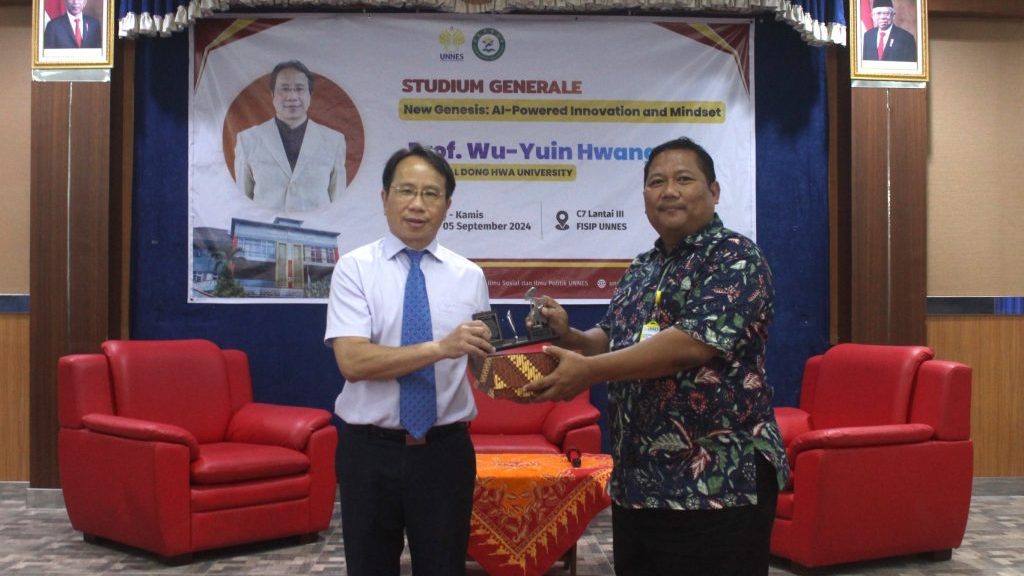
As artificial intelligence (AI) continues to influence global education systems, Universitas Negeri Semarang (UNNES) is positioning itself as a hub for forward-thinking discussions on how technology can be used responsibly to enhance learning.
At a public lecture titled “AI-Powered Innovation and Mindset,” hosted by the Civic Education Study Program (PPKn) at the Faculty of Social Sciences and Political Science (FISIP), UNNES welcomed Prof. Wu Yuin Hwang, Dean of the Faculty of Science and Engineering at National Dong Hwa University, Taiwan, as keynote speaker. The event, held on Wednesday, brought together students, lecturers, and education professionals eager to explore AI’s growing influence in academic spaces.
Prof. Hwang discussed how AI is evolving from a basic information tool into a collaborative learning partner. “AI can now learn and grow with humans—it’s becoming part of the learning process itself,” he said, highlighting examples such as adaptive language learning systems that improve through user interaction. He also shared speculative insights about future technologies that could preserve human cognition for intergenerational communication.
Dr. Arif Purnomo, Dean of FISIP UNNES, said the university viewed the event as a catalyst for long-term academic cooperation.
“We hope this is the start of ongoing research collaborations and joint projects between our institutions,” Dr. Arif said. “UNNES is committed to exploring innovation while upholding ethical and humanistic values in education.”
The event encouraged students to consider both the potential and limitations of AI in academic life. Discussions focused on how technology can complement human creativity rather than replace it. Participants expressed excitement about applying AI tools in their studies but also voiced concern about maintaining academic integrity and critical thinking.
By fostering dialogue on the balance between innovation and ethics, UNNES aims to cultivate a generation of educators and learners who understand AI not just as a technological convenience, but as a transformative force requiring reflection and responsibility. The collaboration with National Dong Hwa University reflects UNNES’s growing emphasis on international partnerships that advance digital literacy, ethical education, and sustainable innovation.