
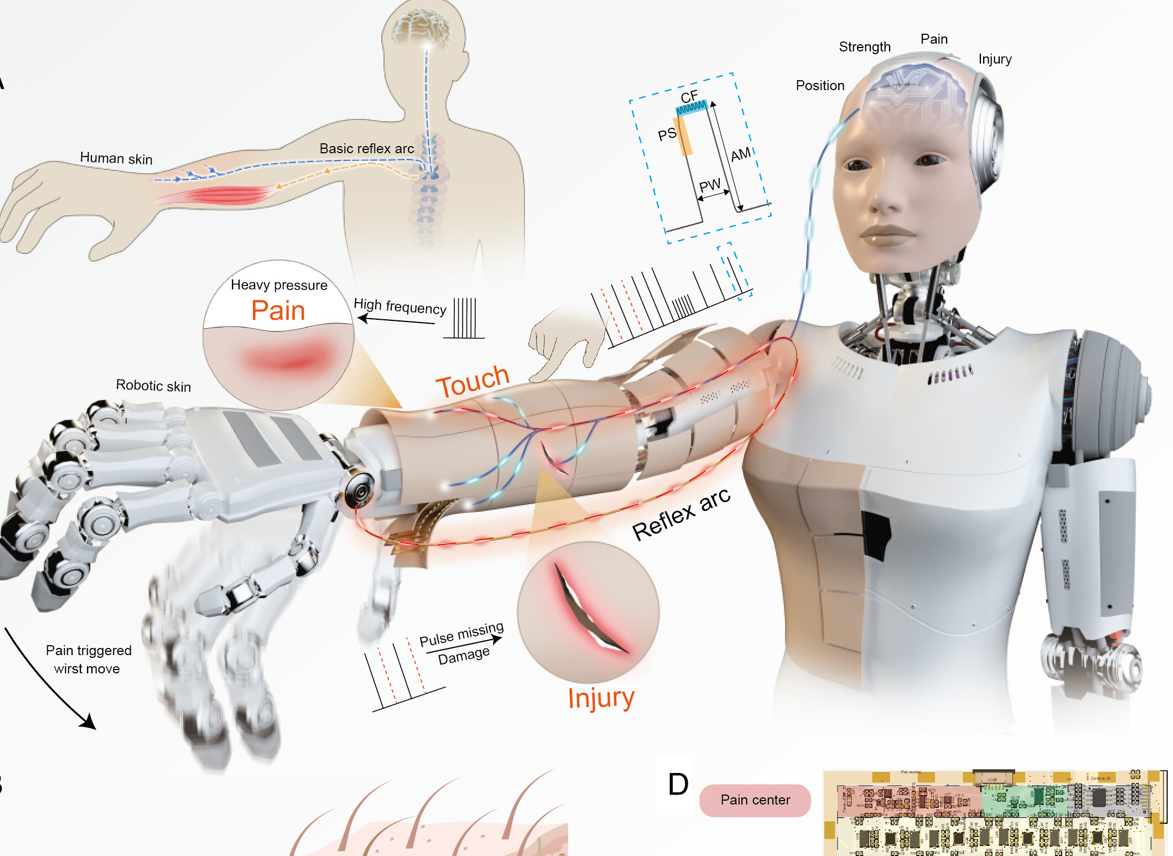
Scientists at the City University of Hong Kong have developed an electronic skin that allows humanoid robots to detect potentially harmful contact and respond with rapid, pain-like reflexes, a development intended to make interactions with humans safer.
The neuromorphic robotic electronic skin, or NRE-skin, is designed to replicate key aspects of the human nervous system. It enables robots to sense touch, interpret the intensity of physical contact and initiate protective responses without relying entirely on central processing, bringing robotic behaviour closer to human-like reflexes.
See also: Swiss Team Unveils First Fully Edible Robot
The e-skin consists of four layers arranged in a hierarchical, neural-inspired architecture modelled after human skin. During light contact, the system generates spike-like electrical signals that are sent to the robot’s central processing units for response assessment. When pressure exceeds a predefined threshold, the skin produces a high-voltage signal that bypasses the processor and is sent directly to the actuating motors, triggering an automatic recoil.
Researchers say this near-instant reaction is intended to protect both the robot and nearby humans by preventing contact forces from escalating. By allowing the robot to adjust its behaviour immediately, the system could reduce the risk of injury and mechanical damage during close interaction.
Source: China’s Humanoid Robotics Surge Sparks Warnings of Market Saturation
Beyond reflex responses, the NRE-skin can also monitor itself for damage. Each sensor periodically emits a signal to confirm functionality, and if a signal is no longer detected, the system identifies the affected area. The damaged sensor module can then be replaced by a technician, or potentially by the humanoid itself in future implementations.
Source: PNAS