
Close Menu
    Facebook X (Twitter) Instagram Threads
    Teknowire
    • Home
    • News
      • Business
        • Tech Startups
        • Corporate Strategies
        • Market Trends
        • Investments
      • Breaking Tech News
      • Policy
      • Industry Announcements
      • Mergers & Acquisitions
    • AI
      • AI Innovations
      • Ethics & Regulations
      • ML & Automation
      • Robotics & Drones
    • Internet
      • Social Media
      • Digital Marketing
      • Web Development
      • Streaming
    • Device
      • Accessories
      • Laptops
      • PC
      • Smartphone
      • Smartwatch
      • Tablet
    • Game
      • Esports
      • Game Reviews
      • Mobile Gaming
      • PC & Console Gaming
    • Apps
      • Cybersecurity
      • Mobile Apps
      • Operating Systems
      • Productivity Tools
      • Web & Cloud Services
    • Transportation
      • Electric Vehicle
      • Autonomous & Connected Vehicles
      • Battery & Charging
      • E-Bikes & E-Scooters
    • Science
      • Biotechnology
      • Quantum Computing
      • Space Exploration
      • Sustainable Tech
    • Others
      • Guide
      • How To
    Subscribe
    Teknowire
    Home » Transportation » Autonomous & Connected Vehicles » Xpeng Introduces X-Mind AI to Predict Future Traffic Scenarios for Smarter Autonomous Driving
    Autonomous & Connected Vehicles

    Xpeng Introduces X-Mind AI to Predict Future Traffic Scenarios for Smarter Autonomous Driving

    The new Physical AI framework uses predictive reasoning and visual simulation to help autonomous vehicles anticipate road conditions before making driving decisions.
    By Gary RussellJune 30, 2026No Comments4 Mins Read
    Share Facebook Twitter Pinterest LinkedIn Tumblr Email Copy Link
    Credit: Xpeng
    Share
    Facebook Twitter LinkedIn Pinterest Email Copy Link

    Chinese electric vehicle manufacturer Xpeng has introduced X-Mind, a next-generation artificial intelligence framework designed to improve autonomous driving by enabling vehicles to anticipate how traffic situations may develop before making driving decisions.

    The company revealed the technology during its Foundation Model Workshop at the Computer Vision and Pattern Recognition (CVPR) conference in Denver, positioning X-Mind as a major advancement in predictive reasoning for intelligent vehicles.

    Rather than responding only to current sensor information, X-Mind enables autonomous systems to evaluate potential future road conditions, helping vehicles make safer and more informed driving decisions.

    Predicting the Road Ahead

    At the core of X-Mind is a predictive planning approach that Xpeng describes as a “visual chain of thought.” Instead of reacting solely to what cameras and sensors detect at the present moment, the AI creates a short-term simulation of how surrounding traffic may evolve over the next few seconds before selecting an appropriate driving action.

    To achieve this, X-Mind employs a component known as Thought Sketch, which converts projections of twelve future visual frames into a compact representation consisting of just 96 information tokens.

    This compression process retains critical driving information—including road geometry, traffic light status, nearby vehicle movement, and navigation objectives—while filtering out visual details that are unnecessary for planning. The result is a more efficient model capable of reasoning about future events without overwhelming onboard computing resources.

    Faster Predictions with Lower Computing Requirements

    Another key feature of the framework is Recurrent Block Diffusion, a prediction engine capable of generating multiple future traffic scenarios in a single processing cycle.

    Traditional predictive models often require repeated calculations or complex three-dimensional scene reconstruction, increasing computational demands and slowing response times. Xpeng says its approach produces high-quality predictions with significantly lower inference latency, making the system practical for deployment on automotive-grade processors.

    The company believes this balance between prediction quality and computational efficiency is essential for bringing advanced autonomous driving technology into production vehicles.

    Better Performance in Challenging Traffic Situations

    According to Xpeng, internal evaluations demonstrated measurable improvements over conventional vision-language-action autonomous driving models.

    The company reported lower lateral and longitudinal displacement errors, indicating greater accuracy in predicting vehicle positioning and future motion. These improvements became particularly evident in complicated driving environments involving unusual traffic behavior, rapidly changing road conditions, and uncommon scenarios that often challenge conventional autonomous systems.

    By forecasting how surrounding vehicles, pedestrians, and infrastructure are likely to behave, X-Mind aims to improve safety while helping autonomous vehicles make smoother, more compliant driving decisions.

    Expanding Xpeng’s Physical AI Ecosystem

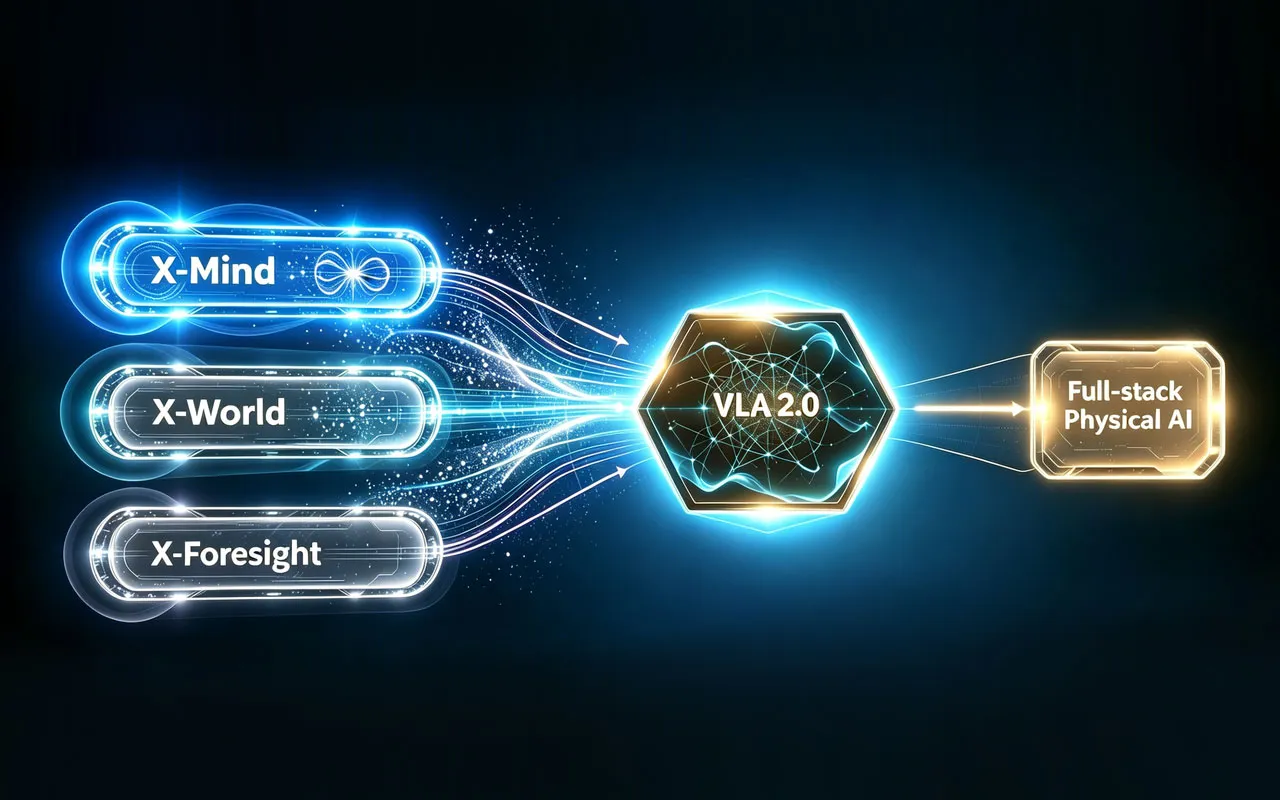
    X-Mind represents the latest addition to Xpeng’s broader Physical AI research initiative, joining two previously introduced foundation models: X-World and X-Foresight.

    Together, the three systems serve complementary purposes within the company’s autonomous driving architecture:

    • X-Mind focuses on predictive reasoning and decision-making.
    • X-World generates controllable virtual environments for AI learning and simulation.
    • X-Foresight concentrates on long-range forecasting and environmental prediction.

    By combining these capabilities, Xpeng aims to create a unified AI platform capable of understanding, predicting, and interacting with complex physical environments.

    Looking Beyond Autonomous Vehicles

    Although X-Mind has been developed primarily for intelligent driving systems, Xpeng believes the underlying technology has applications beyond passenger vehicles.

    The company is exploring how its Physical AI architecture could support future embodied artificial intelligence systems, including intelligent robots and autonomous machines that must interpret dynamic environments and make real-time decisions in the physical world.

    As competition in autonomous mobility accelerates, manufacturers are increasingly shifting from purely reactive driving systems toward predictive AI capable of anticipating future events. Xpeng’s latest research reflects that broader industry trend, with the company investing in foundation models designed to improve decision-making, safety, and real-world autonomy across multiple AI-powered platforms.

    Source: EVMagz

    Artificial Intelligence Asia Automotive AI Automotive Technology Autonomous Driving Autonomous Vehicles China Computer Vision CVPR Denver Intelligent Vehicles Machine Learning Mobility Technology Physical AI Predictive AI Research Self-Driving Cars Vision-Language-Action Models X-Mind Xpeng
    Follow on Google News Follow on Flipboard
    Share. Facebook Twitter Pinterest LinkedIn Tumblr Telegram Email Copy Link
    Previous ArticleWaymo Ends Uber Robotaxi Partnership in Phoenix as Both Companies Expand Independent Strategies
    Next Article Lenovo Confirms Compact Legion Y700 Gaming Tablet With 5G Ahead of August Launch
    Gary Russell
    • Website

    Studied in management and journalism. Gary been covering the startup and e-business scene since 2017.

    Related Posts

    iQoo Reportedly Developing Compact Gaming Tablet With Next-Generation Snapdragon Chip

    June 30, 2026

    Lenovo Confirms Compact Legion Y700 Gaming Tablet With 5G Ahead of August Launch

    June 30, 2026

    Waymo Ends Uber Robotaxi Partnership in Phoenix as Both Companies Expand Independent Strategies

    June 30, 2026
    Add A Comment
    Leave A Reply Cancel Reply

    Latest Post

    Amazon Signs UK Power Purchase Agreement for Egg Power’s 90 MW Chirmorie Wind Farm

    June 30, 2026

    Sony Plans to Win Back PC Gamers With New Accessories, Portable Hardware, and PlayStation Exclusives

    June 30, 2026

    Google Pixel Watch 5 FCC Filing Reveals Satellite Connectivity, UWB, and Wi-Fi 6 Ahead of Launch

    June 30, 2026

    Philips Hue Bridge Pro Firmware Update Reportedly Bricks Some Devices, Users Urged to Disable Auto Updates

    June 30, 2026

    iQoo Reportedly Developing Compact Gaming Tablet With Next-Generation Snapdragon Chip

    June 30, 2026
    About

    Teknowire is a dedicated technology news portal that delivers the latest insights, trends, and developments shaping the future of innovation. From breakthroughs in consumer electronics and artificial intelligence to emerging startups, software trends, and global tech policy, we bring our readers accurate, timely, and accessible coverage of the world’s most dynamic industry.

    Founded with a mission to simplify complex technology for a broader audience, Teknowire serves professionals, enthusiasts, entrepreneurs, and everyday users who want to stay informed about how technology is transforming business, society, and daily life. We prioritize clarity, depth, and reliability in every story — whether it’s a breaking headline, a product launch, or an in-depth feature.

    Subscribe

    Subscribe to Updates

    Get the latest tech news from Teknowire.

    Policies
    • Ownership & Funding
    • Editorial Policy
    • Privacy Policy
    • Actionable Feedback Policy
    • Artificial Intelligence (AI) Policy
    • Cookie Policy
    • Corrections Policy
    • Diversity Policy
    • Ethics Policy
    Facebook X (Twitter) Instagram Pinterest Threads
    • Home
    • About Us
    • Advertising
    • Privacy Policy
    • Cookie Policy
    • Artificial Intelligence (AI) Policy
    • Contact
    © 2026 Teknowire. Designed by Teknowire.

    Type above and press Enter to search. Press Esc to cancel.