
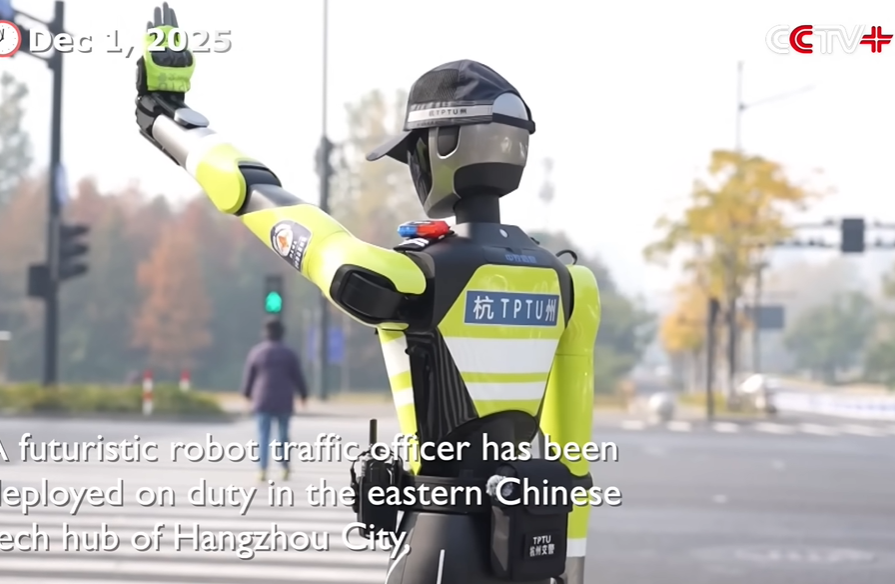
An AI-powered traffic-control robot has begun operating on the streets of Hangzhou, marking the use of automation in real-time traffic management. The unit, named Hangxing No. 1, was deployed on December 1 at a busy intersection in the city’s Binjiang district as part of a trial run overseen by the Hangzhou Traffic Police Tactical Unit.
Equipped with high-definition cameras and sensors, the robot is programmed to assist human officers by guiding both vehicles and pedestrians during peak hours. Police officials say it performs standard traffic gestures learned from real officers, including commands such as “go straight” and “stop.” It can also activate a digital whistle and synchronise its movements with existing traffic-signal systems. “The robot performs standard traffic command gestures — such as ‘go straight’ and ‘stop’ — which were trained directly from the movements of real officers,” said Zhang Wanzhe of the Binjiang traffic police brigade.
See also: Unitree G1 Robot Showcases Human-like Basketball Performance in Viral Clip
Beyond managing traffic flow, Hangxing No. 1 scans for violations including helmetless riders, vehicles crossing stop lines and pedestrians crossing against red lights. When detecting an infraction, the system delivers an immediate voice reminder rather than issuing fines. Officials say this approach prioritises “polite intervention” to encourage safer behaviour at intersections.
The robot’s AI model is designed to improve through continuous exposure to real road environments, learning from different traffic patterns and conditions. Authorities expect future software upgrades to enable expanded functions, including offering directions, providing safety guidance and supporting more complex verbal exchanges through large language model capabilities.
See also: XPeng’s Humanoid Robot Iron Stuns Audience With Lifelike Movements at Live Debut
While officials did not detail battery performance, reports from deployments of similar patrol robots in other regions suggest a typical operating time of six to eight hours per charge. Hangzhou traffic authorities say data from the current trial will determine whether more units will be rolled out across the city.
Source: CGTN