
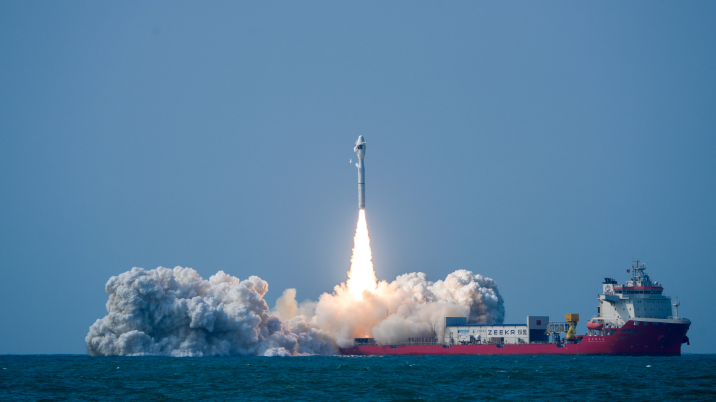
China launched its commercial Smart Dragon-3 carrier rocket on Feb. 12, placing seven satellites into their planned orbit in a mission that included a Pakistani Earth observation satellite. The launch took place at 8:37 p.m. UTC (2:37 p.m. Beijing time) from waters off Yangjiang in Guangdong Province and was conducted by the Taiyuan Satellite Launch Center.
The Smart Dragon-3 (SD-3) mission marked the fourth commercial launch in which the rocket carried multiple satellites, underscoring its ability to accommodate diverse payloads. Multi-satellite launches are generally viewed as more cost-effective for customers, a factor that has made them increasingly attractive in the commercial space market.
See also: ESA Showcases Artemis II Moon Rocket Rollout in New Time-lapse
Among the payloads was Pakistan’s PRSC-EO2, the country’s second indigenous Earth observation satellite. The satellite is designed to gather remote sensing data aimed at strengthening Pakistan’s capabilities in land mapping, environmental monitoring and disaster assessment, as well as the management of natural resources.
The launch of PRSC-EO2 aboard a Chinese rocket was described in the original article as “a milestone achievement in the space cooperation between China and Pakistan,” highlighting the growing collaboration between the two countries in space technology and satellite development.
See also: Nasa Scientists Trace Auroral Arc Formation to Magnetic Space Waves
The successful offshore launch further demonstrates China’s expanding commercial launch infrastructure and its push to offer flexible, sea-based launch services for domestic and international clients.
Source: CGTN