
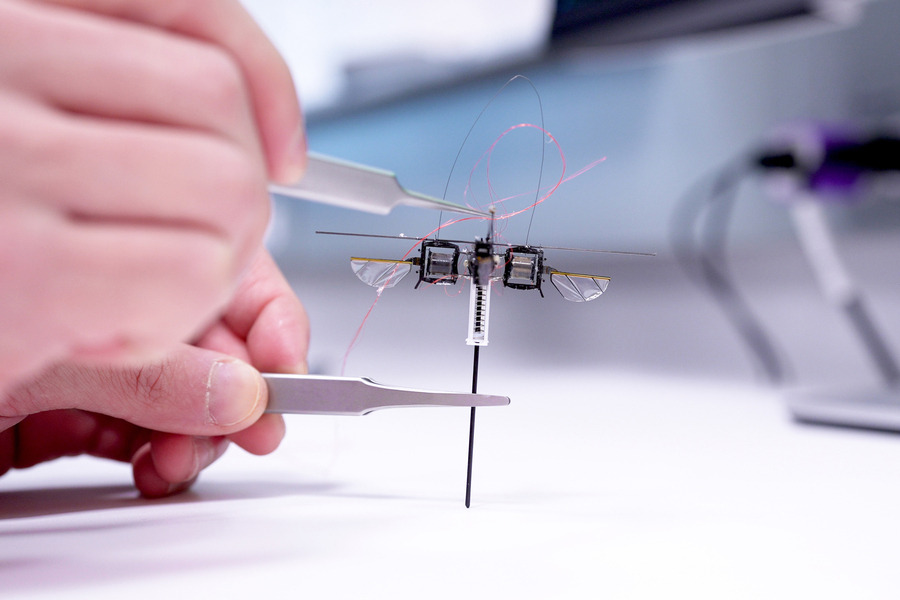
Engineers at the Massachusetts Institute of Technology (MIT) are developing a bee-inspired robot capable of flipping and hovering, part of a new generation of miniature machines that could one day take on pollination tasks in places where natural bees cannot survive.
The lightweight device, which weighs less than a paperclip, uses soft artificial muscles that flap its wings up to 400 times per second. Led by Kevin Chen at MIT’s Soft and Micro Robotics Lab, the project aims to replicate the agility and resilience of bumblebees.
The team envisions potential applications ranging from greenhouse farming under ultraviolet lighting to extraterrestrial agriculture. Yi-Hsuan Hsiao, a PhD student on the project, said: “If you’re going to grow something on Mars, you probably don’t want to bring a lot of natural insects to do the pollination. That’s where our robot could potentially come into play.”
Researchers are also experimenting with an alternative design that combines hopping and flying, allowing for greater efficiency. The hopping prototype, smaller than a human thumb, consumes about 60% less energy than the flying version and can carry payloads up to ten times heavier.
Although current models require a tethered power source due to the challenge of miniaturizing batteries, Chen estimates it may take two to three decades before such robots are viable for widespread use. For now, the work marks a step toward future applications of insect-scale robotics in agriculture and beyond.