
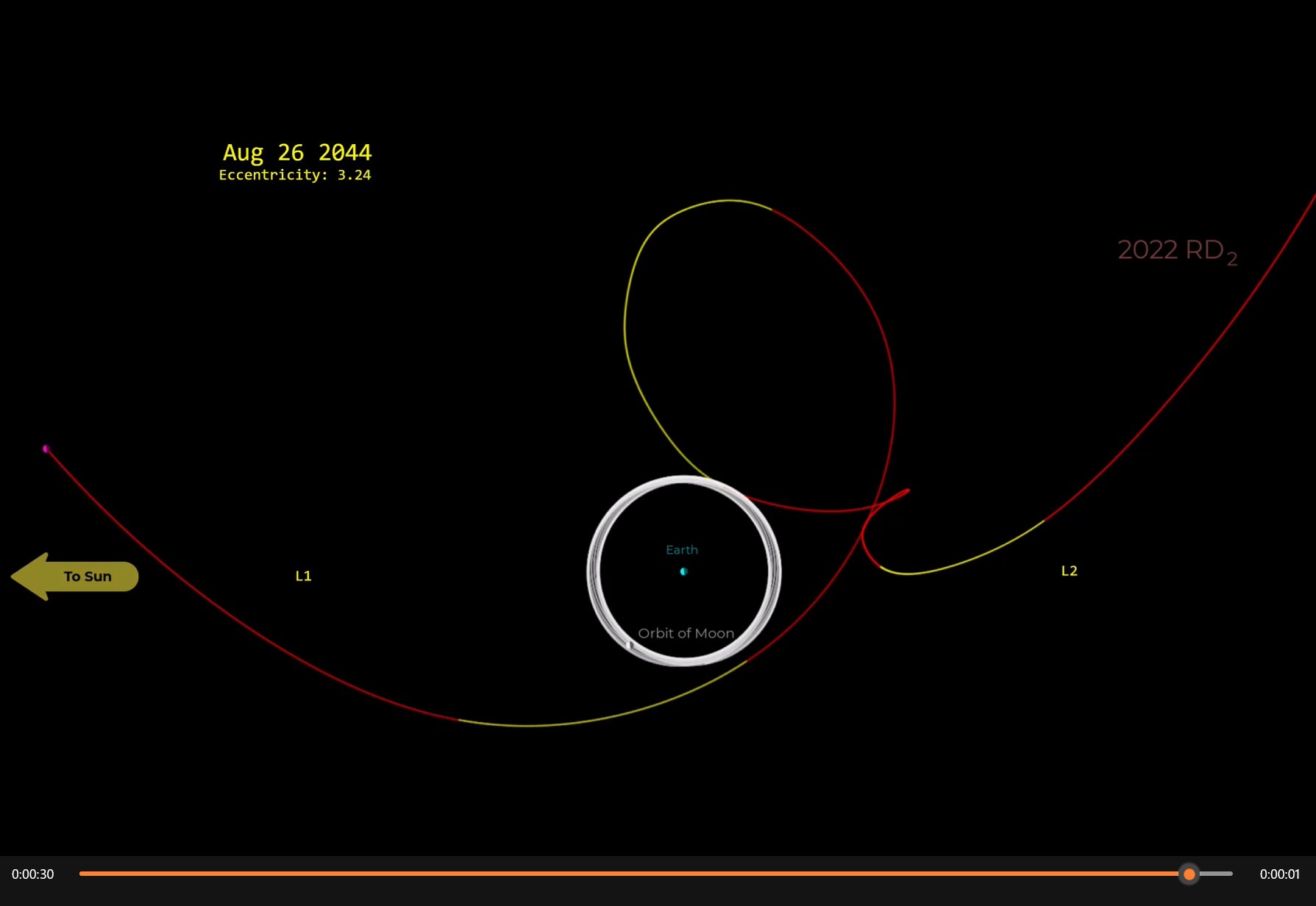
Scientists are monitoring a small asteroid known as 2022 RD2, which is expected to enter Earth’s orbital path in the coming decades. The object belongs to a group of celestial bodies called Arjunas, a secondary asteroid belt containing near-Earth objects with Earth-like orbits. According to the original report, some observers questioned whether the asteroid might be an artificial probe, but its behaviour was described as consistent with a natural object.
The current trajectory indicates that the asteroid will be temporarily captured by the gravitational influence of Earth and the Moon on multiple occasions. Researchers project three orbital passes: between November 12 and December 12, 2043, between February 29 and May 21, 2044, and between July 10 and July 29, 2044. During this period, 2022 RD2 is expected to loop around the planet before returning to its original solar orbit.
See also: Astronomers Confirm First Coronal Mass Ejection Detected Beyond the Sun
Observation teams caution that the asteroid’s behaviour could change over time, as small shifts in trajectory may accumulate in the years leading up to its arrival. For this reason, astronomers are continuously updating their tracking models to refine predictions. While the asteroid does not currently pose a threat, researchers emphasise the importance of monitoring in case of future deviations.
Studies have already begun to evaluate the probability of an impact far beyond the initial orbital capture window. After the three temporary loops around Earth, the asteroid could become dynamically unstable. The original article notes that the estimated chance of collision falls at 0.097%, with the risk window projected between 2080 and 2114.
The scientific community maintains that the asteroid does not present immediate danger, but the monitoring process forms part of broader efforts to improve planetary-defence readiness. As tracking accuracy increases over time, astronomers expect to provide more precise assessments of 2022 RD2’s long-term behaviour.
Source: IOPscience