
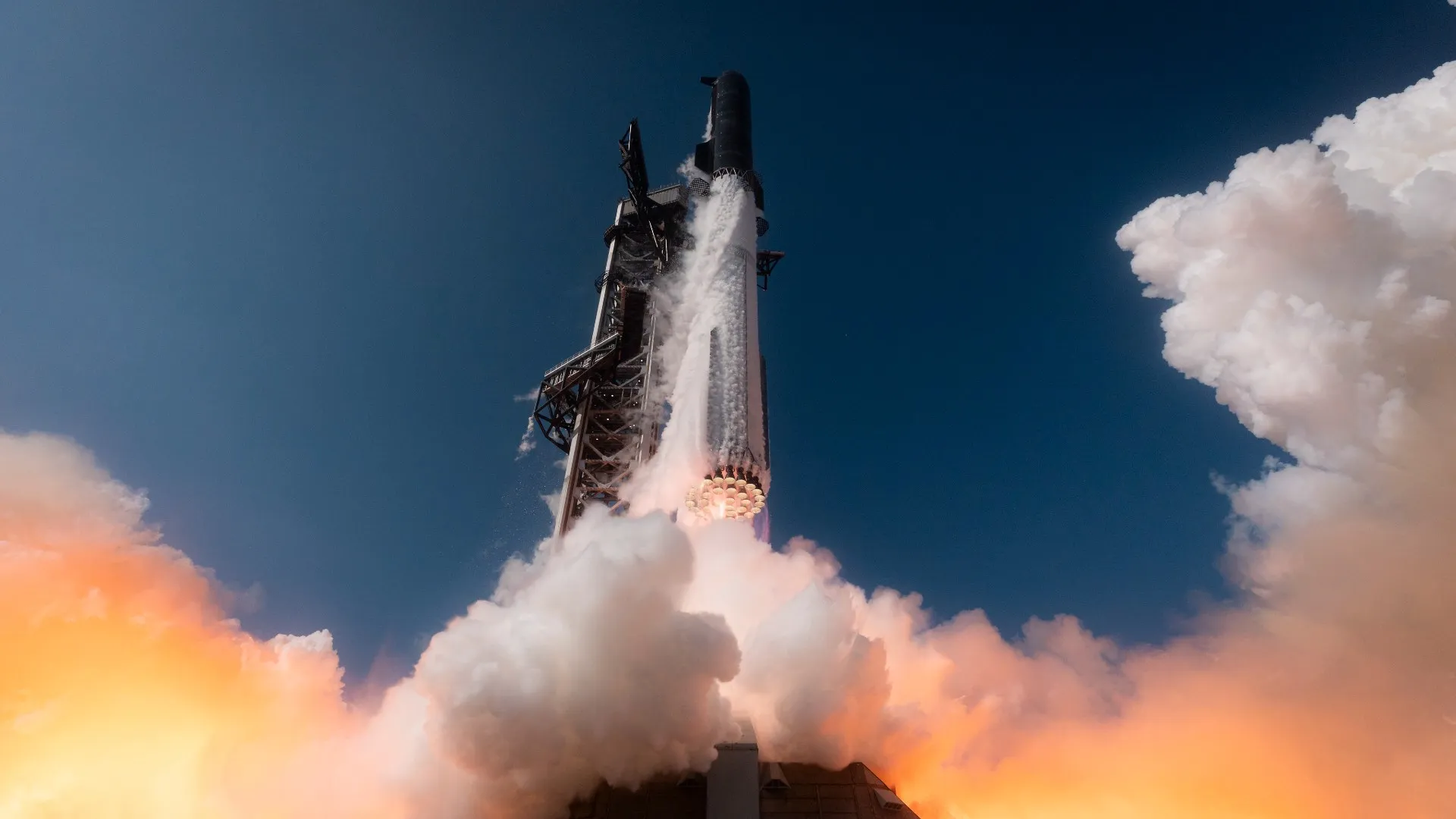
SpaceX is targeting July 17 for the 13th flight test of its Starship launch system, as the company continues to advance development of its fully reusable rocket with a mission focused on vehicle reliability and next-generation satellite deployment.
The launch window is scheduled to open at 6:45 a.m. Jakarta time (5:45 p.m. CT on July 16) and will remain available for 90 minutes. A live webcast is expected to begin about 30 minutes before liftoff.
Booster and Upper Stage Receive Key Upgrades
Flight 13 will follow a mission profile similar to the previous Starship test, including launch, stage separation, a return flight for the Super Heavy booster and a controlled splashdown of the Starship upper stage.
Both stages have received hardware and software upgrades following issues encountered during the previous mission.
For the Super Heavy booster, SpaceX has modified the engine startup sequence after differences in Raptor engine ignition timing caused the vehicle’s flip maneuver to deviate during the last flight. Engineers have also introduced hardware improvements to increase engine relight reliability and updated engine alarm and abort logic after five Raptor engines failed to restart during the previous boostback burn.
The Starship upper stage has also undergone propulsion system improvements after one of its vacuum-optimized Raptor engines shut down during the previous mission.
“Several hardware and operational modifications have been made to address the interconnected causes with additional reliability improvements planned in upcoming versions of the Raptor engine,” SpaceX said.
First Starlink Version 3 Deployment
The mission will also mark the first deployment of Starlink Version 3 satellites aboard Starship.
Twenty satellites are scheduled for release during the flight before deploying their solar arrays and communications antennas and attempting to establish laser links with the existing Starlink network.
The satellites will remain on the same suborbital trajectory as Starship and are expected to burn up during atmospheric reentry about 20 minutes after deployment.
Six satellites have been fitted with cameras to capture images of Starship’s heat shield during reentry, providing engineers with additional data as the company works toward future return-to-launch-site operations.
Continued Testing of Thermal Protection
SpaceX is also using Flight 13 to evaluate several new heat shield technologies.
The company has installed modified thermal protection tiles, new attachment methods and load-sensing tiles designed to measure structural performance under higher aerodynamic loads.
Several tiles have also been painted white to simulate missing heat shield tiles, providing visual reference points for onboard imaging systems during atmospheric reentry.
The July 17 mission represents another milestone in SpaceX’s effort to mature Starship as a fully reusable launch vehicle capable of supporting commercial satellite missions, lunar exploration and future journeys to Mars.
Source: SpaceMagz