
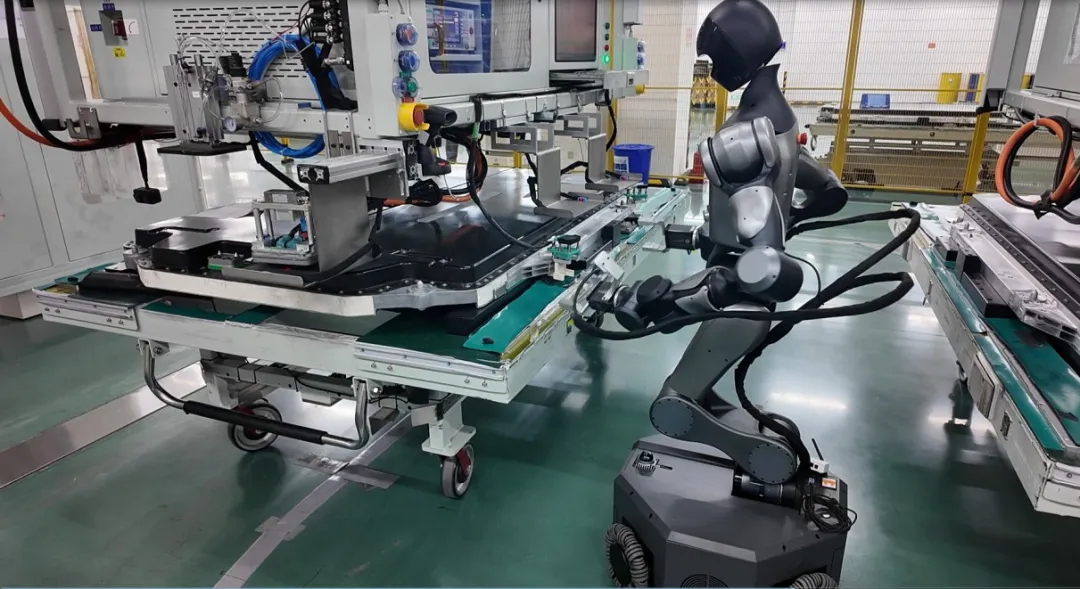
China’s CATL has begun deploying humanoid robots on mass electric vehicle battery production lines, claiming a level of performance that matches skilled human workers and marking a milestone in factory automation as rivals continue to test similar technologies.
The world’s largest battery maker said its Moz humanoid robot, developed by its Spirit AI subsidiary, has been commissioned at scale on what it described as the first power battery pack production line to achieve large-scale use of humanoid robots. The move comes as Tesla has faced reported challenges deploying its Optimus robot in factories, including overheating joints and reliability issues.
See also: Robot Bartender Powered by Nvidia Technology Debuts at Las Vegas Hockey Arena
Unlike earlier demonstrations that focused on simple pick-and-place tasks, CATL said the Moz robots are operating at critical quality assurance stages of battery assembly. These include attaching battery connectors that require high levels of precision, speed and consistency. CATL said the robots’ performance now matches that of experienced human workers.
The company said the robots have achieved a 99% insertion success rate by relying on an end-to-end vision system that allows them to adjust in real time to variations in materials and connection points. “Moz demonstrated strong environmental perception and task generalization capabilities,” CATL said, adding that the robots can accurately control the force applied to delicate wiring to avoid damage.
See also: AI Traffic Robot Begins Trial in Hangzhou
The deployment highlights the rapid pace of humanoid robot development in China, where numerous companies are investing heavily in industrial robotics. Analysts have warned that the sector could face overcapacity similar to that seen in China’s electric vehicle and battery industries, but CATL’s move suggests leading manufacturers are already finding large-scale, practical uses for the technology.
Source: CNC