
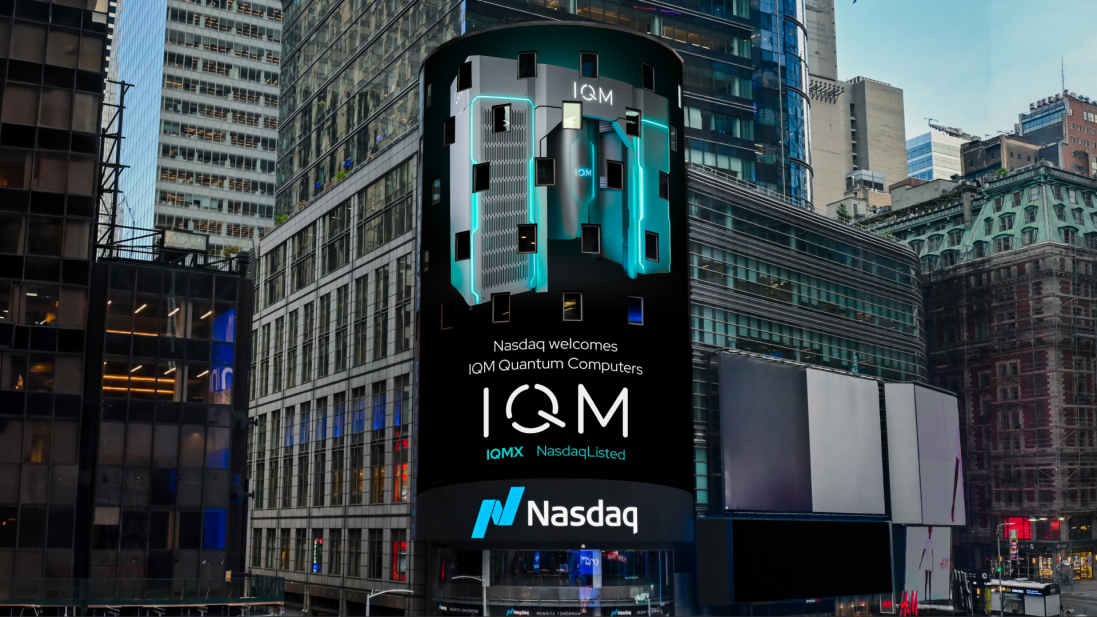
Finnish quantum computing company IQM has begun trading on the Nasdaq following the completion of its merger with a special purpose acquisition company (SPAC), giving the company an initial valuation of approximately US$1.9 billion as it seeks to strengthen its position in the rapidly evolving quantum computing industry.
While the public listing marks a significant milestone for Europe’s quantum technology sector, investor enthusiasm remained subdued during the company’s market debut, reflecting broader uncertainty surrounding the commercialization timeline for quantum computing.
Building Commercial Quantum Systems
Founded in 2018 as a spinout from Aalto University in Espoo, Finland, IQM develops full-stack quantum computing systems, including superconducting quantum processors, complete quantum computers and cloud-based quantum computing services.
Rather than focusing solely on research, the company supplies physical quantum computers to advanced computing facilities while also providing remote access to quantum hardware through cloud platforms.
Its customer base includes research organizations such as Finland’s VTT Technical Research Centre and Germany’s Leibniz Supercomputing Centre, with recent expansion into private-sector deployments.
According to Chief Executive Officer and co-founder Jan Goetz, the company’s customer base grew from eight organizations in 2024 to 22 in 2025.
“We sell computers into advanced supercomputing centers and data centers, and we sell computing time through the cloud.”
Commercial Promise Still Developing
Like many companies in the quantum computing sector, IQM acknowledged in its public filing that widespread commercial adoption of quantum computing remains uncertain.
The company noted that large-scale commercial traction may not materialize for some time as the industry continues pursuing quantum advantage—the point at which quantum processors consistently outperform classical supercomputers across practical applications.
Potential future applications include molecular simulation, pharmaceutical development, financial modeling, logistics optimization and advanced materials research, although the timeline for achieving these capabilities remains uncertain.
Despite those challenges, governments and investors continue increasing support for quantum technology development.
Expanding International Presence
IQM has recently strengthened its presence in the United States by establishing a quantum technology center in Maryland and deploying one of its quantum computers at Oak Ridge National Laboratory, which operates under the U.S. Department of Energy.
The expansion aligns with growing public investment in quantum technologies following recent U.S. initiatives aimed at accelerating development of fault-tolerant quantum computing systems.
Goetz said the company expects to benefit from these initiatives while maintaining its European identity.
Alongside its U.S. Nasdaq listing under the ticker IQMX, IQM is also scheduled to begin trading on Nasdaq Helsinki, becoming one of the first European quantum computing companies to secure a public listing in the United States.
European Engineering with Global Ambitions
Although expanding internationally, IQM continues to maintain the majority of its engineering operations in Finland.
Approximately two-thirds of the company’s workforce remains based near Helsinki, with a significant engineering presence in Munich supporting research, development and international deployment activities.
The company has also received substantial public funding from European governments seeking to strengthen regional capabilities in quantum technology.
Positioning for Long-Term Growth
The public listing is expected to generate approximately €198 million (US$226 million) in new capital after transaction costs, complementing the US$300 million the company raised in a private financing round in 2025.
While near-term commercial demand for quantum computers remains limited, IQM views the public listing as an opportunity to strengthen its financial position, expand manufacturing and increase visibility in an industry where technological leadership may determine future competitive advantage.
As governments and technology companies continue investing heavily in quantum research, firms such as IQM are positioning themselves for a market that remains technically challenging today but could become a foundational computing platform over the coming decades.