
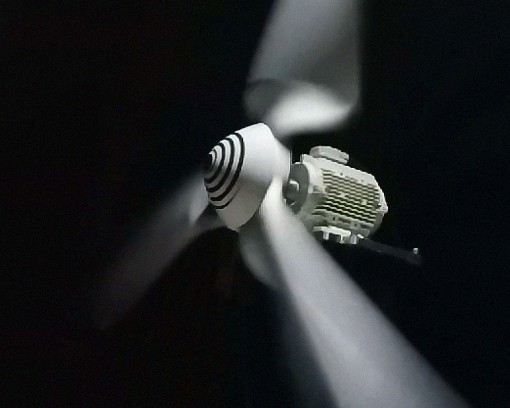
The Fraunhofer Institute for Applied Polymer Research (IAP) and Berlin-based BBF Group have presented the first lightweight prototypes of a small wind turbine designed for high efficiency in low-wind conditions. The project seeks to advance decentralized renewable energy solutions for households, businesses, and remote areas.
According to the institute, the new turbines can begin generating power at wind speeds as low as 2.7 meters per second, significantly below the 4 m/s typically required by standard systems. “At 10 m/s, the rotors reach up to 450 revolutions per minute, generating approximately 2,500 watts of power,” Fraunhofer said. The turbines operate at a noise level of about 40 decibels, roughly equivalent to a household refrigerator, and achieve an efficiency rate of 53%, approaching the theoretical maximum of 59%.
A key innovation lies in the rotor blade construction. The blades are made from fiber composites with a hollow, foam-free structure, reducing overall weight by up to 35%. The components are produced using industrial 3D printing and an automated fiber placement (AFP) process to ensure precise layering and material efficiency.
Fraunhofer said the turbines’ compact and lightweight design makes them suitable for regions with limited wind resources, as well as for off-grid locations such as mountain cabins, island communities, and research stations. They may also be used in disaster relief operations, providing mobile and sustainable power for emergency facilities.
Five prototypes have been delivered to BBF Group for testing under various environmental conditions. Fraunhofer noted that in most cases, installing the turbines requires only notifying local authorities rather than full planning permission. The partners expect the technology to eventually support self-sufficient energy systems combining solar power, battery storage, and small wind units to strengthen local energy resilience.
Source: Fraunhofer Institute