
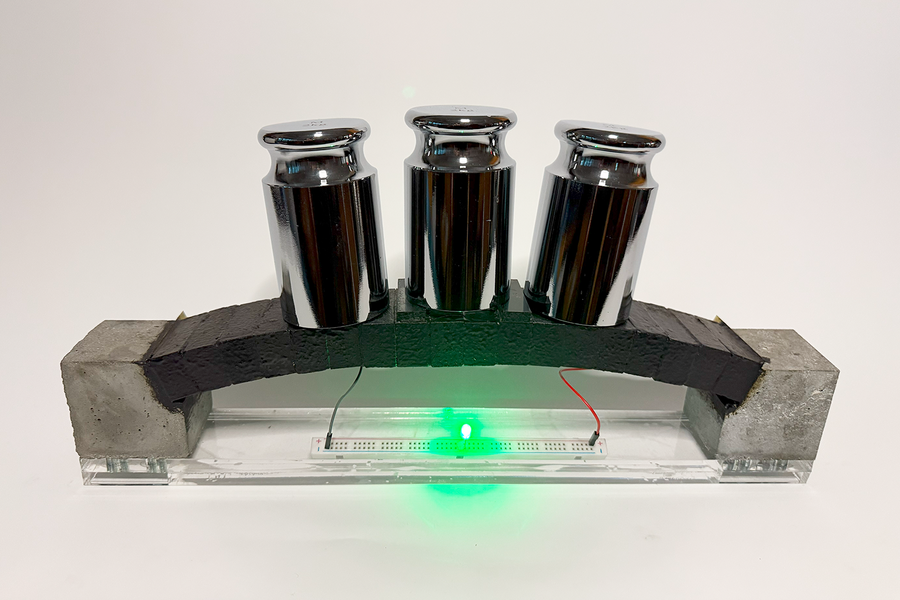
Researchers at the Massachusetts Institute of Technology (MIT) have developed a new form of conductive concrete capable of storing and releasing electrical energy, potentially allowing everyday structures such as walls, bridges, and pavements to double as energy storage systems.
The material, called electron-conducting carbon concrete (ec³), combines cement, water, carbon black, and electrolytes to form a conductive network that can function like a supercapacitor. Recent refinements have increased its energy capacity by nearly tenfold, reducing the volume of material needed to power a home from about 45 cubic meters to just five.
The team achieved the improvement by studying how carbon particles interact with electrolytes at the nanoscale, leading to optimized compositions that enhance conductivity and storage. Experiments using organic electrolytes showed that a cubic meter of the latest version could store over two kilowatt-hours of energy, enough to power a household appliance for a day.
Beyond energy storage, the technology could enable structures to monitor their own integrity by detecting electrical fluctuations caused by stress or damage. Researchers believe this multifunctional capability could make concrete a central component in renewable energy systems.
The MIT team sees the innovation as a step toward buildings and infrastructure that not only provide shelter and support but also contribute directly to clean energy storage — a development that could reshape how cities manage power and sustainability in the future.
Source: MIT