
A group of students from Universitas Negeri Semarang (UNNES) has developed an interactive learning medium using augmented reality technology to help address Indonesia’s ongoing challenge of low numeracy literacy among students.
The innovation, titled 3D-Storybook Rawa Pening, combines local cultural narratives from the Rawa Pening area with three-dimensional augmented reality (AR) visuals and a Challenge-Based Learning (CBL) approach. The project is designed to help junior high school students better understand mathematical concepts, particularly congruence and similarity in geometry, through contextual and experiential learning.
See also: UNNES Launches INARA App to Modernize History Learning with Inclusive, Gender-Responsive Design
The learning medium was developed by Habba Arrizal Anas and Sabrina Riski Astutiningtyas under the supervision of Adi Satrio Ardiansyah, S.Pd., M.Pd. The project draws inspiration from the daily life and cultural environment surrounding Rawa Pening, using real-world objects such as stilt houses and fish cages as visual references for geometric learning.
Through AR visuals, students can observe three-dimensional representations of these objects as if they were physically present at the site. The CBL framework guides students through identifying real-life problems, formulating questions and solving mathematical challenges linked to everyday situations.
See also: UNNES Launches Electric Motorcycle Prototype to Support Indonesia’s Renewable Energy Transition
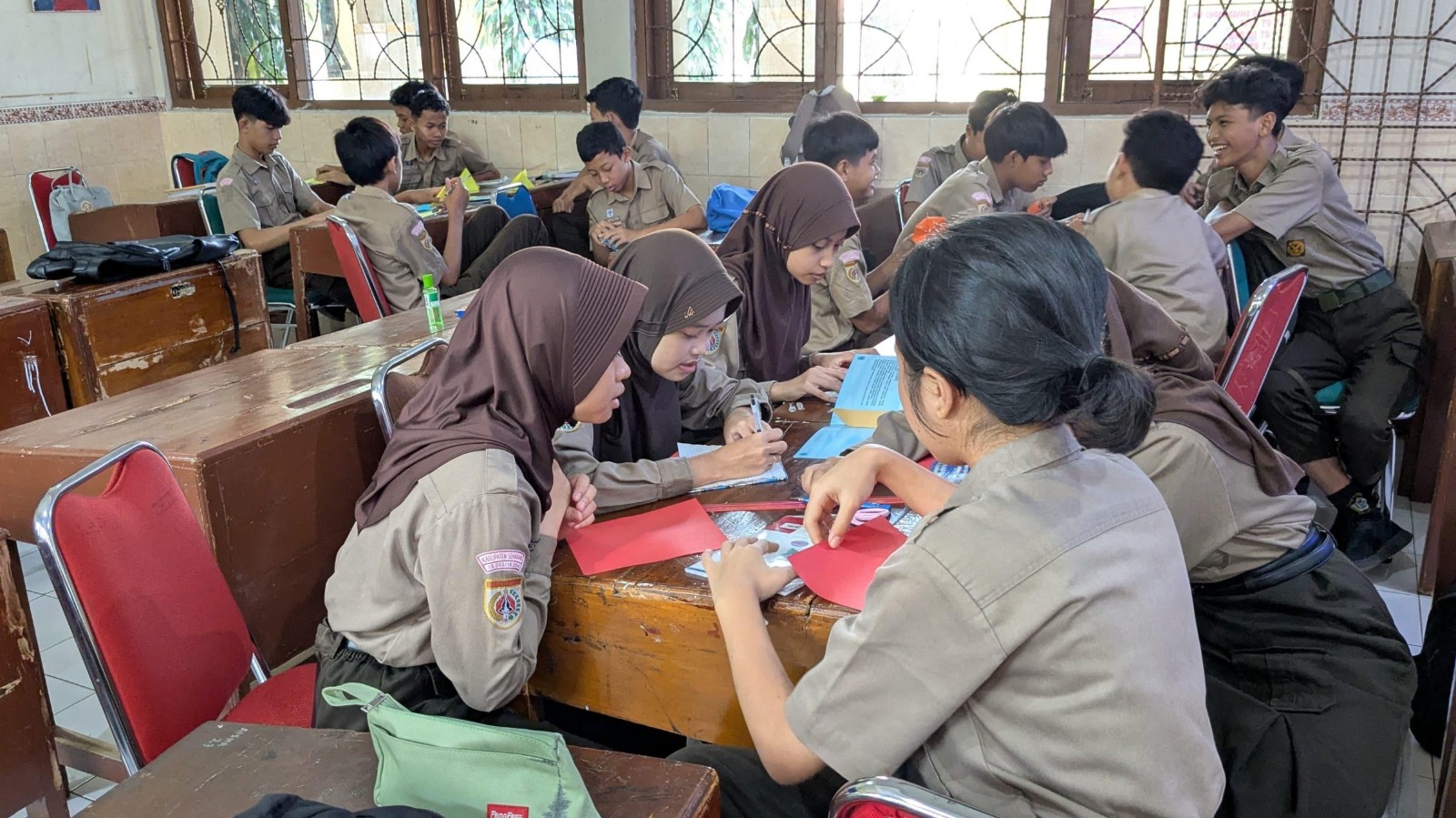
A trial of the medium at SMP Negeri 1 Ungaran showed strong results. The learning tool was rated feasible for classroom use at 86.5%, easy to understand at 97.25%, and effective in improving students’ numeracy literacy at 98%, according to the developers.
UNNES said the initiative supports the United Nations Sustainable Development Goals, particularly SDG 4 on Quality Education, by promoting inclusive, engaging and technologically supported learning rooted in local wisdom.