

Astronomers using NASA’s James Webb Space Telescope have identified how crystalline silicates — minerals found in comets despite their icy origins — can form and spread across young planetary systems, according to new research published in Nature.
Webb observations of a young protostar known as EC 53 show that these heat-formed crystals originate in the hot, inner regions of the disk of gas and dust surrounding the star. The telescope also detected strong outflows capable of transporting the material to the cold outer regions of the disk, where comets are expected to form.
See also: Mars Express Image Shows Wind-carved Formations Shaped by Sandblasting on Mars
“EC 53’s layered outflows may lift up these newly formed crystalline silicates and transfer them outward, like they’re on a cosmic highway,” said Jeong-Eun Lee, lead author of the study and a professor at Seoul National University. The findings help explain a long-standing puzzle about why comets in the distant Kuiper Belt and Oort Cloud contain minerals that require high temperatures to form.
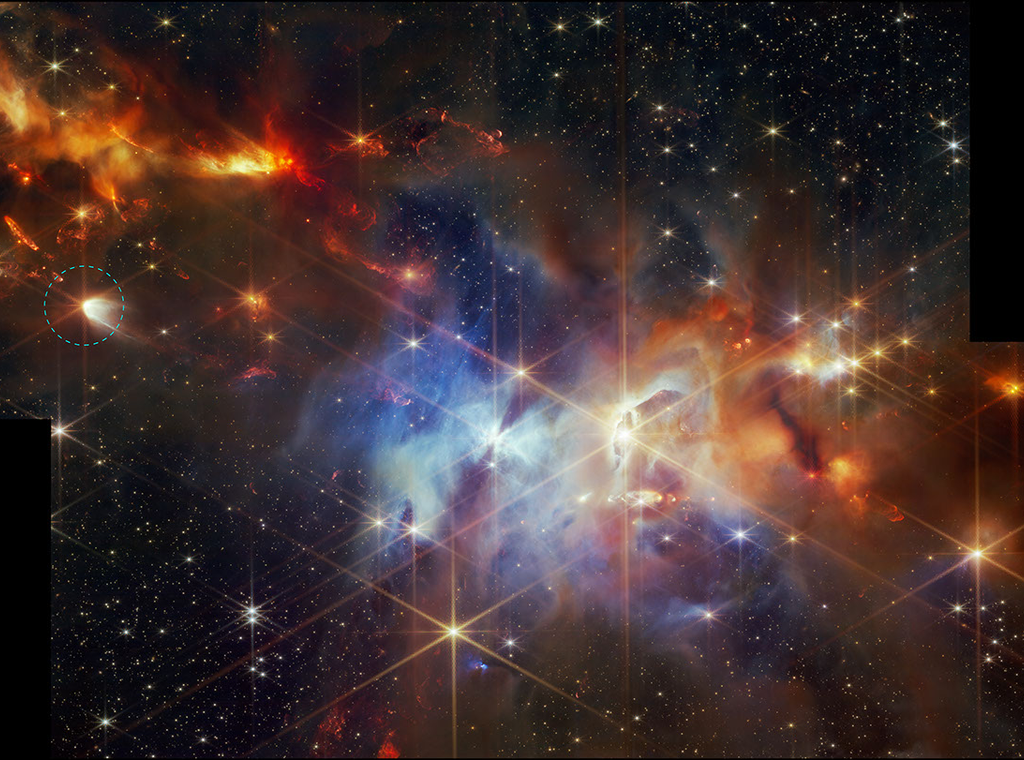
Using Webb’s Mid-Infrared Instrument (MIRI), researchers mapped the chemical composition and movement of dust around the star during both quiet periods and regular outbursts. EC 53 experiences predictable bursts roughly every 18 months, during which it rapidly accretes material while ejecting powerful jets and winds that may scatter newly formed crystals across the disk.
See also: NASA’s StarBurst Mission Clears Key Tests Ahead of Planned Launch
Scientists say the results provide a clearer picture of how mineral-rich dust can be redistributed in young star systems, eventually contributing to comet formation and, over longer timescales, the building blocks of planets. Webb is an international mission led by NASA in partnership with the European Space Agency and the Canadian Space Agency.
Source: Nasa