
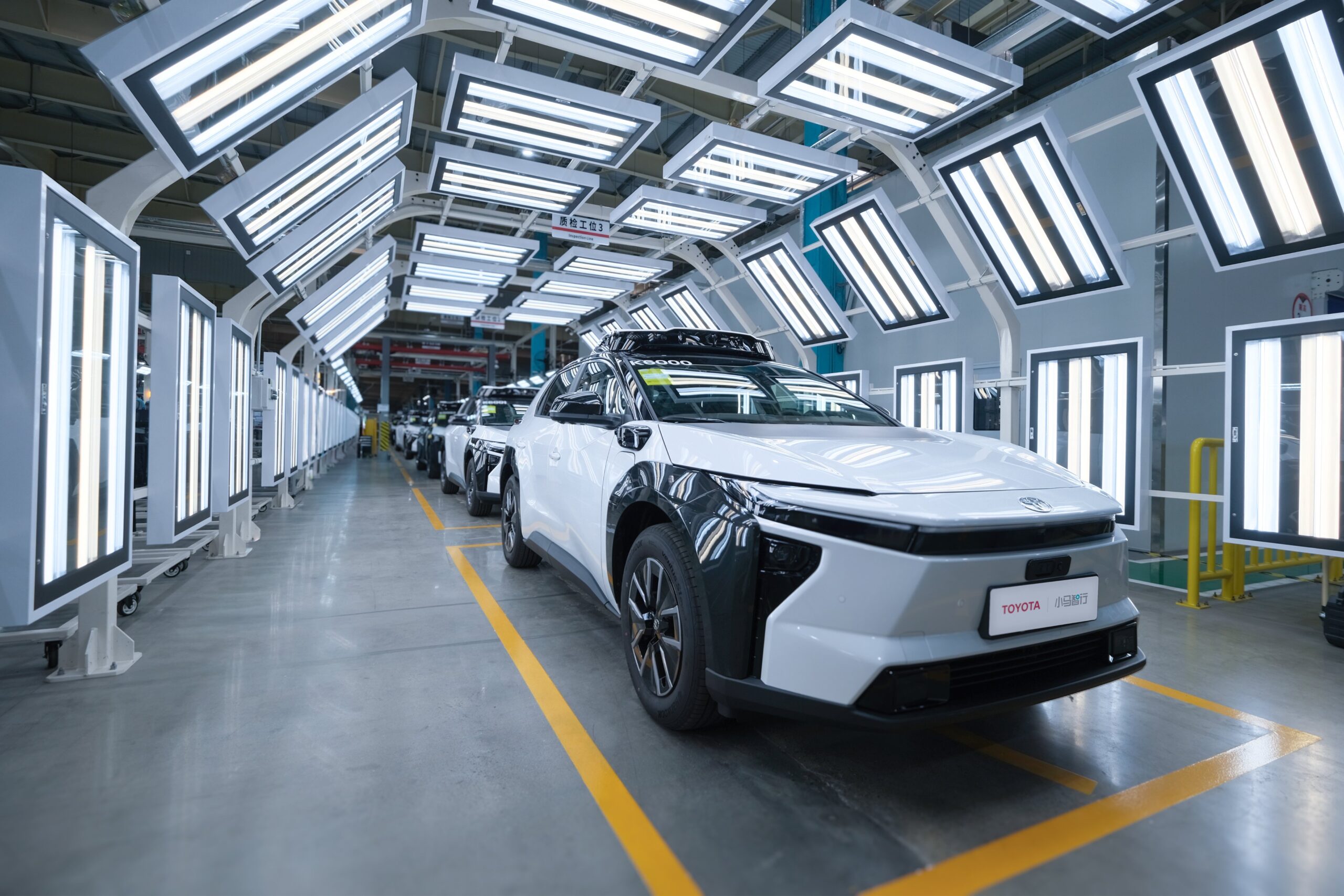
Pony.ai has begun mass production of the bZ4X robotaxi developed in partnership with Toyota, as the first production vehicle rolled off the assembly line in China, the autonomous driving company said.
The start of mass production marks a shift in the Pony.ai–Toyota collaboration from limited-scale testing toward broader commercial deployment. The partnership spans autonomous driving software, vehicle manufacturing, and supply chain coordination, reflecting a more integrated approach to robotaxi development.
See also: Mercedes-Benz Turns to NVIDIA for AI-focused Redesign of S-Class
The bZ4X robotaxi is jointly developed by Pony.ai, Toyota Motor China and GAC Toyota, with production carried out at a GAC Toyota facility that serves as one of Toyota’s global model plants. The partners plan to manufacture more than 1,000 bZ4X robotaxis in 2026, with vehicles gradually entering commercial service in China’s Tier 1 cities.
The rollout supports Pony.ai’s objective of expanding its total robotaxi fleet to more than 3,000 vehicles, as competition in China’s autonomous mobility sector intensifies and companies seek to demonstrate economic viability at scale.
See also: UpdatePromise Integrates UVeye Vehicle Inspection Data Into Dealership Service Systems
The vehicle is equipped with Pony.ai’s seventh-generation autonomous driving system, which uses fully automotive-grade components. Pony.ai has said the bill of materials cost for the Gen-7 autonomous driving kit has been reduced by 70% compared with the previous generation, a change aimed at improving cost efficiency for large-scale deployment. The Gen-7 lineup, which includes three robotaxi models, was unveiled in April last year, with two models entering commercial service in November.
In addition to autonomous driving functions, the Gen-7 robotaxis incorporate features intended to improve passenger experience, such as automatic unlocking, in-cabin voice interaction, online media services and pre-conditioning of cabin temperature, along with refinements to acceleration and braking behavior.
Source: EVMagz