
Close Menu
    Facebook X (Twitter) Instagram Threads
    Teknowire
    • Home
    • News
      • Business
        • Tech Startups
        • Corporate Strategies
        • Market Trends
        • Investments
      • Breaking Tech News
      • Policy
      • Industry Announcements
      • Mergers & Acquisitions
    • AI
      • AI Innovations
      • Ethics & Regulations
      • ML & Automation
      • Robotics & Drones
    • Internet
      • Social Media
      • Digital Marketing
      • Web Development
      • Streaming
    • Device
      • Accessories
      • Laptops
      • PC
      • Smartphone
      • Smartwatch
      • Tablet
    • Game
      • Esports
      • Game Reviews
      • Mobile Gaming
      • PC & Console Gaming
    • Apps
      • Cybersecurity
      • Mobile Apps
      • Operating Systems
      • Productivity Tools
      • Web & Cloud Services
    • Transportation
      • Electric Vehicle
      • Autonomous & Connected Vehicles
      • Battery & Charging
      • E-Bikes & E-Scooters
    • Science
      • Biotechnology
      • Quantum Computing
      • Space Exploration
      • Sustainable Tech
    • Others
      • Guide
      • How To
    Donation
    Trending Topics:
    • AI Innovations
    • Investments
    • Tech Startups
    • Smartphone
    • Social Media
    • Policy
    • Space Exploration
    • Cybersecurity
    Teknowire
    Home » Science » Space Exploration » Astronomers Confirm First Coronal Mass Ejection Detected Beyond the Sun
    Space Exploration

    Astronomers Confirm First Coronal Mass Ejection Detected Beyond the Sun

    ESA’s XMM-Newton and LOFAR capture rare stellar eruption capable of stripping planetary atmospheres
    By Lalu JazidiNovember 22, 2025No Comments3 Mins Read
    Share Facebook Twitter Pinterest WhatsApp Email LinkedIn Copy Link Reddit Telegram Threads
    Prefer on Google
    Google News
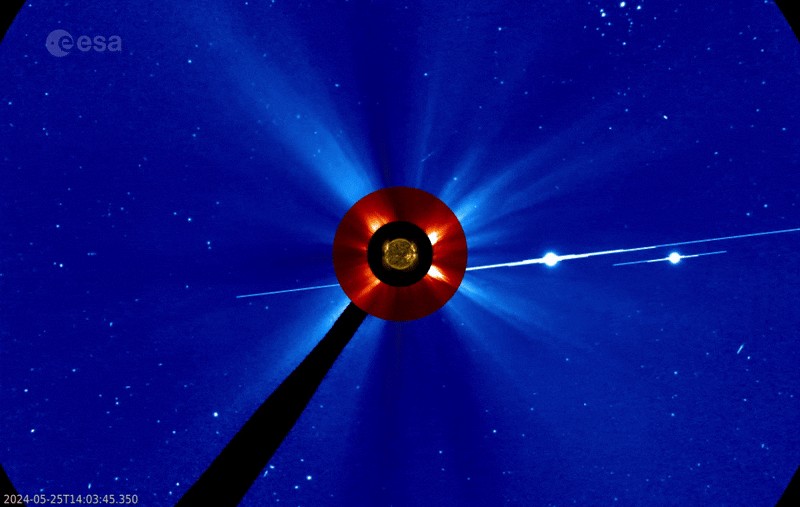
    A coronal mass ejection coming from the Sun on 27 May 2024
    A coronal mass ejection coming from the Sun on 27 May 2024 (Credit: ESA)
    Share
    Facebook Twitter LinkedIn Pinterest Email Copy Link

    Astronomers have confirmed the first clear detection of a coronal mass ejection (CME) from a star other than the Sun, using data from the European Space Agency’s XMM-Newton space observatory and the LOFAR radio telescope. The event marks a breakthrough in stellar research, capturing an explosive outburst powerful enough to erode the atmosphere of any nearby planet. The discovery, outlined in a new Nature study, was identified around a red dwarf located roughly 130 light-years away. The research team said previous attempts only inferred such eruptions, but none had previously confirmed material escaping into space.

    The signal was identified as a short burst of low-frequency radio waves created as the CME blasted through the star’s outer layers and into interstellar space. According to the researchers, this type of radio emission would not occur unless material had fully broken free of the star’s magnetic field. The team analysed both radio and X-ray observations to determine the object’s temperature, rotation and magnetic activity, information they said was essential for interpreting the event.

    See also: NASA Rover Spots Unusual Rock on Mars

    The eruption was measured at a speed of about 2,400 kilometres per second, a velocity seen in only a tiny fraction of solar CMEs. The star, a rapidly rotating red dwarf with a magnetic field hundreds of times stronger than the Sun’s, is the type most commonly orbited by planets in the Milky Way. The observed CME was dense and fast enough to strip the atmosphere of any nearby world, raising questions about the long-term habitability of planets orbiting active stars.

    Scientists say the result opens a new avenue for understanding space weather on stars other than the Sun. Red dwarfs, despite hosting many of the galaxy’s known exoplanets, may pose significant challenges for the survival of planetary atmospheres if they frequently release eruptions of this magnitude. Researchers involved in the study noted that such findings could reshape assessments of which exoplanets are likely to remain habitable over time.

    See also: Astronomers Identify New Lunar Crater Using NASA Orbiter

    The European Space Agency said the work highlights the scientific importance of XMM-Newton and the value of cross-observatory collaboration. The mission, operating since 1999, continues to contribute to studies of extreme astrophysical environments, including black holes, stellar evolution and high-energy radiation. The agency said the detection resolves a decades-long search for evidence of CMEs beyond the Solar System and will support future investigations into how stars influence the atmospheres of their orbiting planets.

    Source: ESA

    ESA XMM-Newton
    Add as a preferred source on Google
    Share. Facebook Twitter Pinterest LinkedIn Tumblr Telegram Email Copy Link
    Previous ArticleNew Path of Exile 2 League Announced, Free Weekend Trial Set for Mid-December
    Next Article Garmin Patent Points to AMOLED Watch With Solar Power
    Lalu Jazidi

    Studied in political science. Lalu been covering the startup and e-business scene since 2017.

    Related Posts

    Reditus Space Completes ENOS Spacecraft Ahead of First Orbital Reentry Mission

    July 14, 2026

    SpaceX Schedules July 17 Starship Flight 13 to Advance Reusable Launch System

    July 14, 2026

    Blue Origin Targets New Glenn Return to Flight as Explosion Investigation Continues

    July 1, 2026
    Add A Comment
    Leave A Reply Cancel Reply

    Follow Us!
    • Facebook
    • Twitter
    • Pinterest
    • LinkedIn
    • Telegram
    • WhatsApp
    Latest Post

    Rime Raises $24 Million to Advance Enterprise Voice AI Models

    July 16, 2026

    DeepSeek Reportedly Seeks $1.5 Billion Funding at $71 Billion Valuation

    July 16, 2026

    Senra Systems Raises $65 Million to Scale Wire Harness Manufacturing

    July 16, 2026

    Spotify Expands Parent-Managed Accounts to Free Users

    July 16, 2026

    Stripe and Advent Offer More Than $53 Billion to Acquire PayPal

    July 16, 2026
    About

    Teknowire is a dedicated technology news portal that delivers the latest insights, trends, and developments shaping the future of innovation. From breakthroughs in consumer electronics and artificial intelligence to emerging startups, software trends, and global tech policy, we bring our readers accurate, timely, and accessible coverage of the world’s most dynamic industry.

    Founded with a mission to simplify complex technology for a broader audience, Teknowire serves professionals, enthusiasts, entrepreneurs, and everyday users who want to stay informed about how technology is transforming business, society, and daily life. We prioritize clarity, depth, and reliability in every story — whether it’s a breaking headline, a product launch, or an in-depth feature.

    Subscribe to Updates

    Get the latest tech news from Teknowire.

    Policies
    • Ownership & Funding
    • Editorial Policy
    • Privacy Policy
    • Actionable Feedback Policy
    • Artificial Intelligence (AI) Policy
    • Cookie Policy
    • Corrections Policy
    • Diversity Policy
    • Ethics Policy
    Facebook X (Twitter) Pinterest LinkedIn WhatsApp Telegram
    • Home
    • About Us
    • Advertising
    • Privacy Policy
    • Cookie Policy
    • Artificial Intelligence (AI) Policy
    • Donation
    • Contact
    © 2026 Teknowire. Designed by Teknowire.

    Type above and press Enter to search. Press Esc to cancel.