
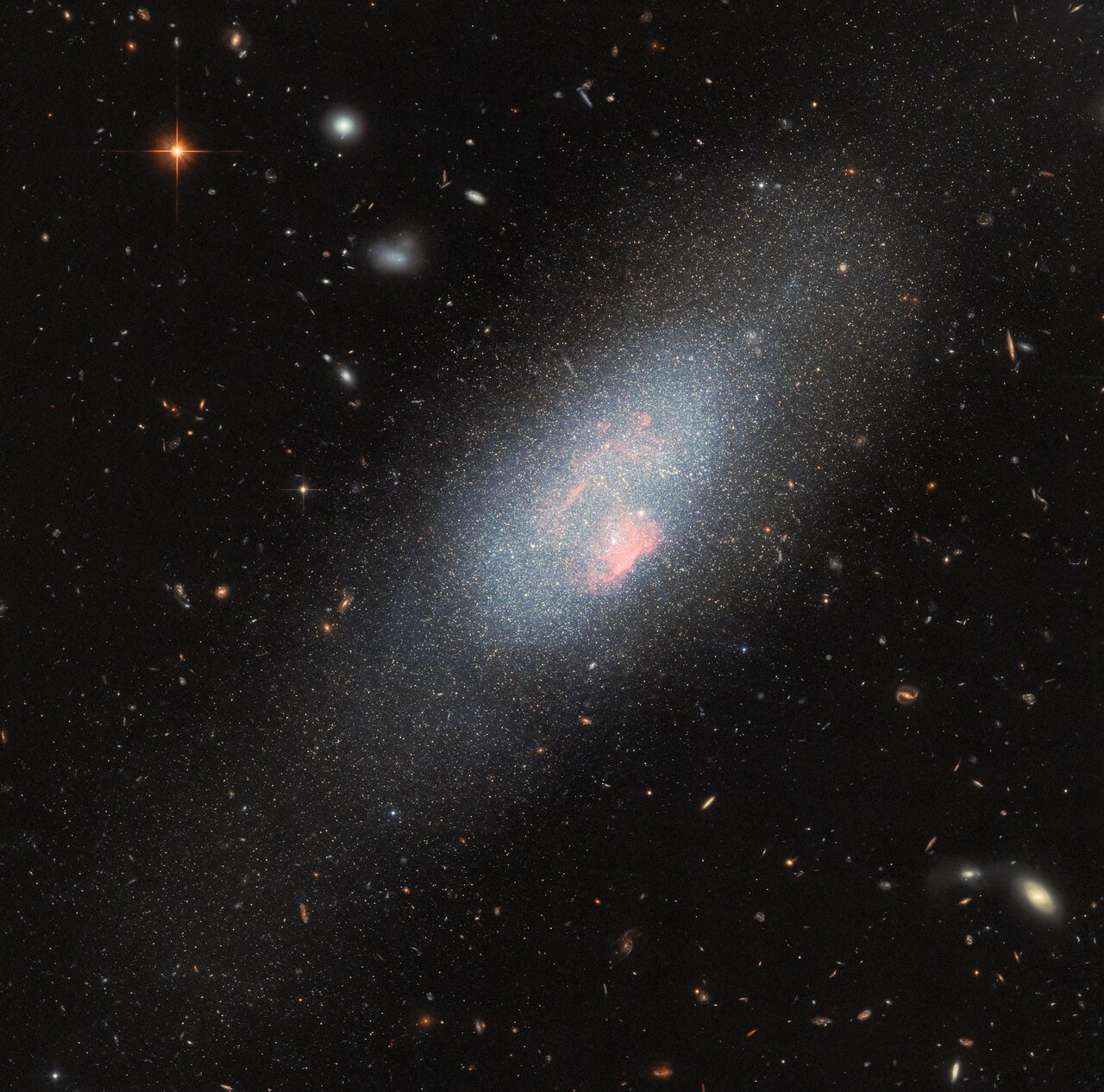
The European Space Agency has released a new Hubble “Picture of the Week” showcasing Markarian 178, a compact dwarf galaxy noted for its unusually bright ultraviolet emission. Located around 13 million light-years away in the constellation Ursa Major, the galaxy contains a dense population of young, hot stars. According to the original article, “the latest ESA/Hubble Picture of the Week features a strikingly bright galaxy called Markarian 178 (Mrk 178).”
In the Hubble image, Mrk 178 appears as a compact blue structure set against a dark background, with its colour indicating an abundance of recently formed stars. A reddish glow concentrated along the galaxy’s edges adds another layer of interest, signalling the presence of Wolf-Rayet stars — a rare and short-lived class of massive, hot stars nearing the end of their life cycles.
See also: Webb Telescope Captures Dwarf Galaxies Linked by Ancient Gas Bridge
Wolf-Rayet stars shed their outer layers through powerful stellar winds and emit intense radiation that ionizes surrounding hydrogen gas, producing a distinct red emission. The original report noted that “these stars are in the final stage of their lives before they explode as supernovae,” eventually forming neutron stars or black holes.
Because Wolf-Rayet stars typically persist for only a few million years, astronomers believe a recent event triggered the burst of star formation in Mrk 178. Deeper imagery captured by the Large Binocular Telescope shows faint tidal features surrounding the galaxy, suggesting that an encounter with a smaller satellite galaxy may have set off the activity.
See also: Asteroid Expected to Join Earth Orbit Sparks Interest in Planetary Defence
Future Hubble observations will aim to further examine the structure and behaviour of Mrk 178, helping scientists better understand the processes driving star formation in dwarf galaxies.
Source: ESA