
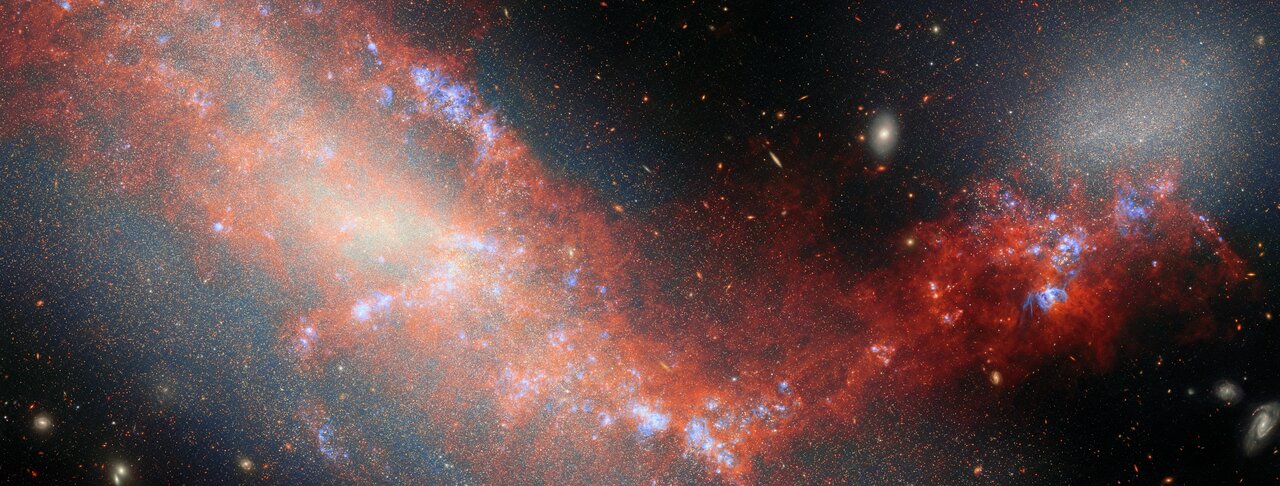
The European Space Agency has released its latest Webb Picture of the Month, featuring two dwarf companion galaxies — NGC 4490 and NGC 4485 — locked in a prolonged gravitational interaction. Located roughly 24 million light-years away in the constellation Canes Venatici, the pair are connected by a stream of gas first drawn between them millions of years ago.
According to ESA, the gas bridge formed about 200 million years ago when the galaxies passed close to each other, and NGC 4490 captured material from its smaller neighbour. As noted in the original description, the galaxies appear to be in “a gravitational dance,” highlighting a rare and detailed view of how dwarf galaxies influence one another over long periods of time.
See also: Scientists Reveal Martian Clocks Run Faster Than Earth Clocks
The exchange of material triggered star formation along the gas stream and has continued into the recent past. Scientists report that dense regions within the bridge began forming stars rapidly, with new stellar clusters emerging just 30 million years ago. These young clusters are visible in the Webb image as bright blue groups along the connecting structure.
The observation was made using Webb’s Near-Infrared Camera (NIRCam) and Mid-Infrared Instrument (MIRI), while data from Hubble’s narrow-band 657N filter contributed to the final composite. In the image, the larger galaxy on the left is NGC 4490, while NGC 4485 appears in the upper right, linked by a prominent red stream of gas.
See also: NASA’s ESCAPADE Mission Records First Images After Launch
The work forms part of the Feedback in Emerging extrAgalactic Star clusTers (FEAST) program, an effort to deepen scientific understanding of how galaxy interactions shape star formation. Researchers say the new image provides a clear timeline of the collision and offers one of the most detailed looks yet at the long-term evolution of dwarf galaxy encounters.