
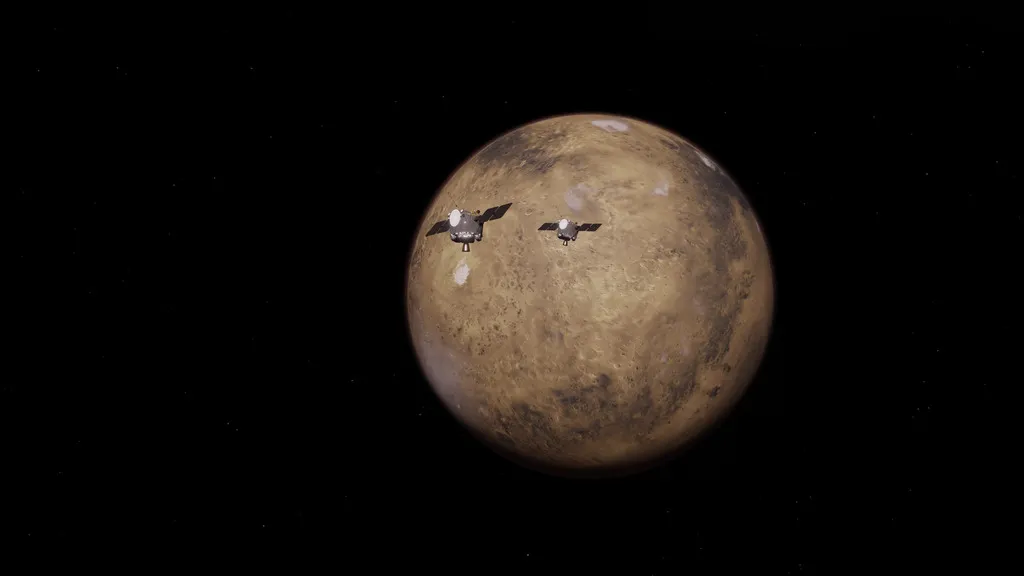
NASA is preparing to launch its ESCAPADE mission, a dual-spacecraft project designed to investigate Mars’ magnetosphere and its interaction with solar wind. The study is expected to improve understanding of how the planet’s thin atmosphere escapes into space, with implications for future human and robotic exploration.
Unlike Earth, Mars lacks a global magnetic field, instead possessing localized magnetic patches. This makes the planet vulnerable to solar wind, which excites atmospheric particles and causes them to drift into space, a process known as atmospheric escape. ESCAPADE, or Escape and Plasma Acceleration and Dynamics Explorers, will measure how these dynamics unfold over time.
The mission will deploy two identical spacecraft into Mars’ orbit to map the planet’s magnetic environment. By studying particle motion and the magnetosphere’s response to solar wind, researchers hope to gain critical insights into atmospheric loss and its impact on planetary evolution.
NASA and its partners postponed an earlier launch attempt but have now scheduled the mission for no earlier than this fall. ESCAPADE will fly aboard Blue Origin’s New Glenn rocket. “The mission will study the structure of Mars’ magnetic field. It will provide insights into how this magnetic field controls the movement of particles around the planet and how the field responds to solar wind,” NASA said.
The two spacecraft reached the Astrotech Space Operations Facility in Titusville, Florida, on September 16, where engineers will conduct inspections and functional tests ahead of final launch preparations.