
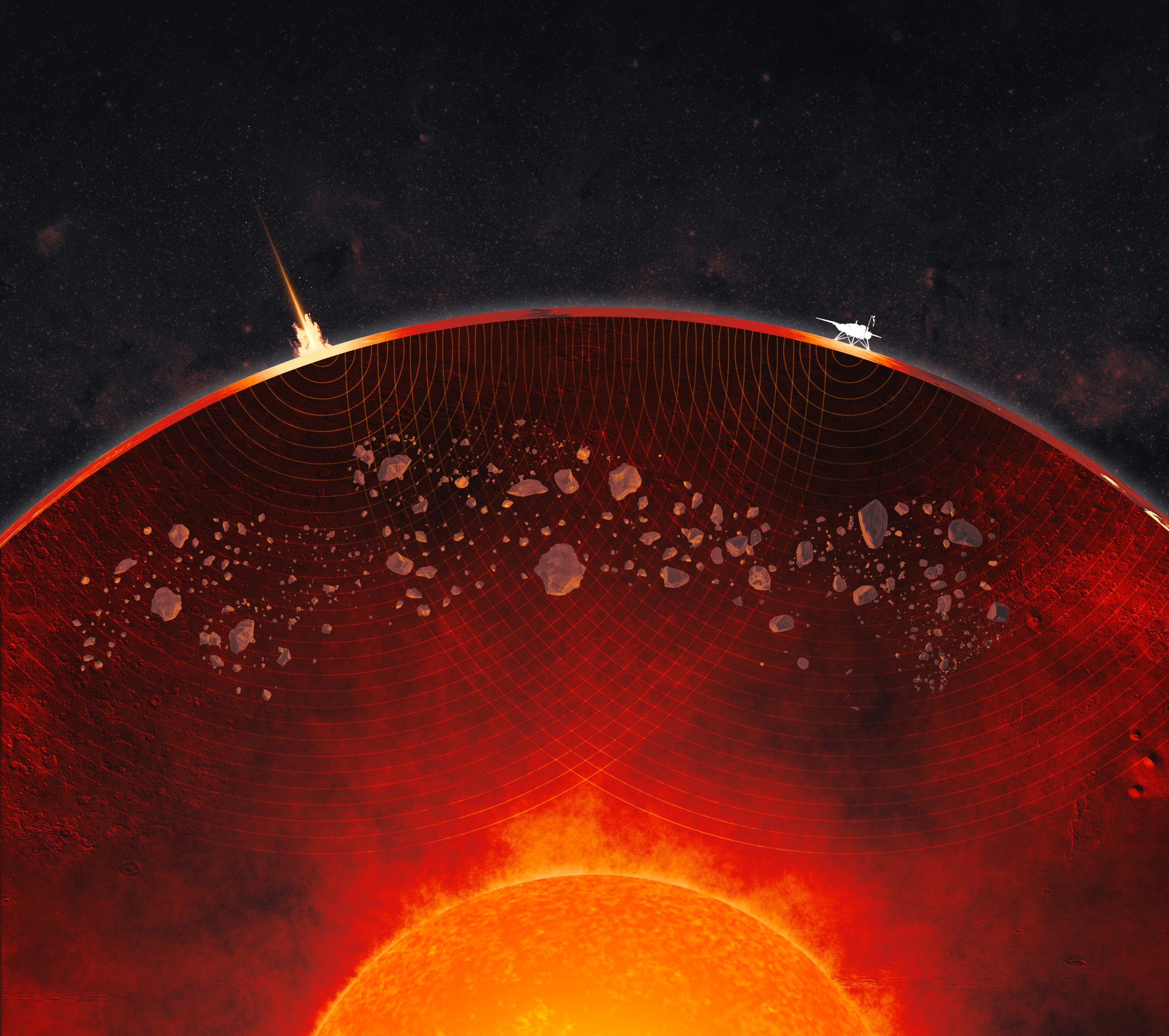
Researchers analyzing seismic data from NASA’s InSight mission have identified large structures deep inside Mars’ mantle that they say date back to the planet’s earliest history.
The findings, published on August 28, are based on seismic waves recorded by the InSight lander, which operated on Mars from 2018 to 2022. During its mission, the robotic probe detected 1,319 marsquakes, allowing scientists to study how waves move through the planet’s interior.
Eight of those quakes generated high-frequency waves that slowed down as they traveled through parts of the mantle, returning scrambled signals. Planet-wide simulations helped researchers locate the cause in a small, localized region.
“They discovered that the slowing down happened in a small, localized region,” the study noted. “Further studies revealed that this region contains lumps of material.”
The lumps are believed to be remnants of asteroid impacts from about 4.5 billion years ago, when collisions between planets and protoplanets were common in the solar system.
Unlike Earth, Mars does not have tectonic plates, meaning the ancient material has remained preserved in the mantle. Scientists say the discovery offers a rare glimpse into the early formation of rocky planets.
The study also suggests that similar features may exist beneath the surfaces of Venus and Mercury, which also lack plate tectonics.