
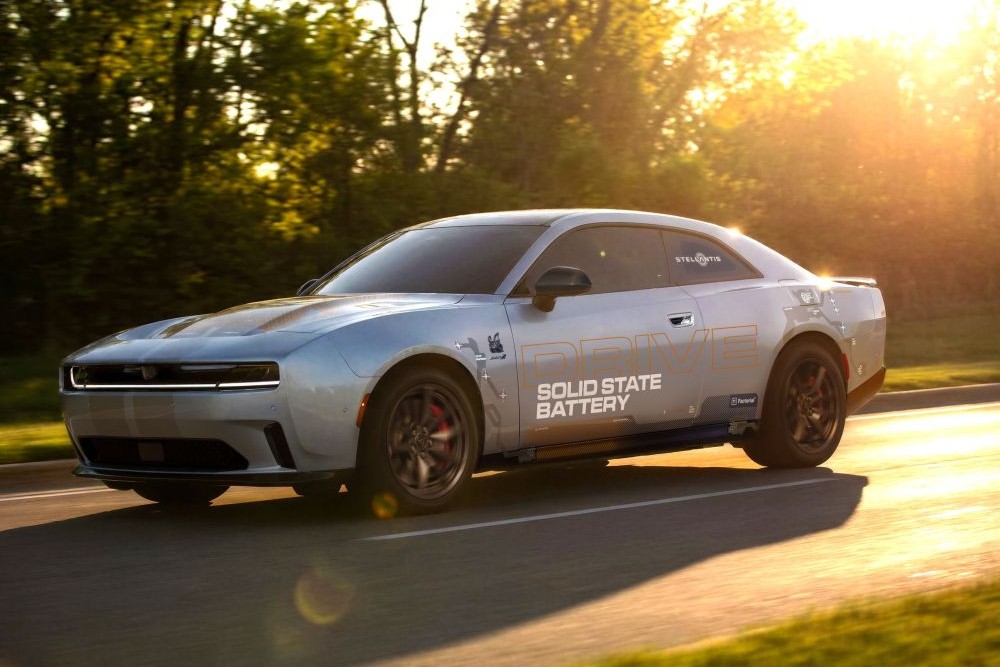
Stellantis has moved its solid-state battery programme from the laboratory to public roads, integrating prototype cells from Factorial Energy into a specially developed Dodge Charger Daytona test vehicle.
The road-testing programme marks a significant milestone for the automaker’s next-generation battery development efforts and represents the first real-world evaluation of the technology in a Stellantis vehicle.
Dodge Charger Daytona Serves as Test Platform
Rather than introducing the technology in a small urban electric vehicle, Stellantis selected a development version of the all-electric Dodge Charger Daytona as its demonstration platform.
The vehicle has been created specifically to assess the performance, safety and reliability of solid-state batteries under real-world driving conditions and is not intended for commercial sale.
The testing programme will focus on validating battery behaviour across a range of operating scenarios while supporting future vehicle integration efforts.
Partnership with Factorial Energy
The project is being carried out in collaboration with Factorial Energy, a Massachusetts-based battery technology company backed by several major automotive manufacturers, including Stellantis, Mercedes-Benz, Hyundai and Kia.
Factorial specialises in solid-state battery technologies designed to replace the liquid electrolytes used in conventional lithium-ion batteries with solid materials, enabling significant improvements in energy density, safety and charging performance.
The Dodge Charger Daytona prototype uses Factorial’s FEST (Factorial Electrolyte System Technology) cells, which combine a lithium-metal anode with a proprietary solid-state electrolyte system.
Higher Energy Density and Faster Charging
According to Factorial, the solid-state cells used in the programme deliver an energy density of up to 375 Wh/kg, significantly higher than that of many current-generation lithium-ion batteries.
The technology also supports rapid charging, allowing the battery to increase its state of charge from 15% to 90% in approximately 18 minutes.
Higher energy density enables more energy to be stored within the same battery volume and weight, potentially increasing driving range while reducing vehicle mass.
These characteristics are widely regarded as key advantages of solid-state technology compared with conventional lithium-ion batteries.
Designed for Extreme Conditions
Another area of focus is thermal performance.
Factorial says the cells can operate across a temperature range extending from -30°C to 45°C, helping address one of the major challenges facing electric vehicles in extremely cold or hot climates.
Improved temperature resilience could help maintain charging performance, efficiency and driving range under conditions that typically affect conventional battery systems.
Building on Previous Demonstrations
The latest programme follows earlier solid-state battery demonstrations involving other automotive manufacturers.
Earlier testing conducted with a modified Mercedes-Benz EQS prototype equipped with Factorial battery technology reportedly achieved a driving distance exceeding 1,200 kilometres on a single charge under test conditions.
The demonstration highlighted the long-range potential that future solid-state batteries may offer when combined with highly efficient vehicle platforms.
Toward Commercialisation
While solid-state technology continues to attract significant industry investment, large-scale commercial deployment remains several years away.
Automakers are currently evaluating whether solid-state batteries can deliver the durability, safety, manufacturability and cost competitiveness required for mass-market electric vehicles.
The industry today primarily relies on lithium iron phosphate (LFP) and nickel manganese cobalt (NMC) battery chemistries. Solid-state alternatives are expected to offer advantages including greater energy density, enhanced safety, longer service life and substantially faster charging times.
For Stellantis, the new Dodge Charger Daytona development vehicle represents an important step toward determining whether solid-state batteries can eventually become a viable replacement for existing EV battery technologies across its future vehicle lineup.
Source: EVMagz