
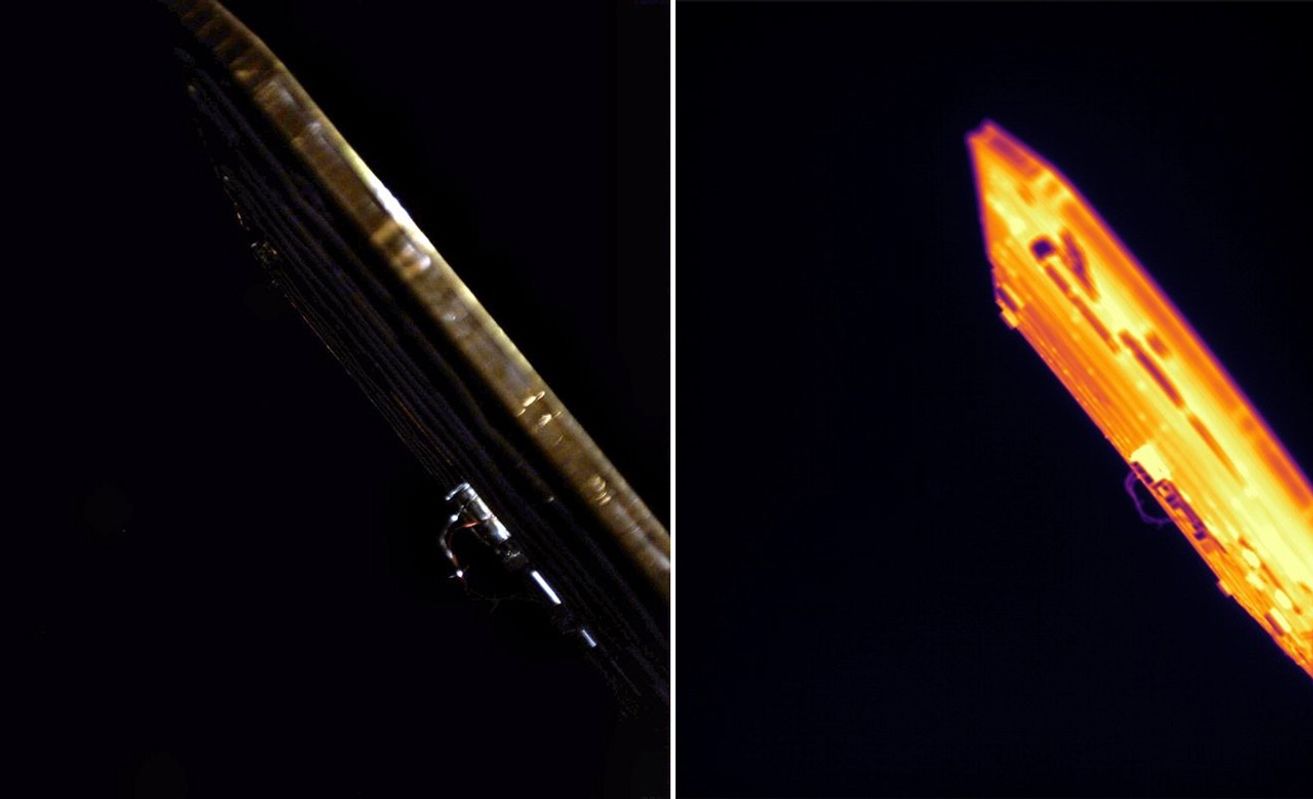
NASA’s ESCAPADE mission has transmitted its first images roughly one week after launch, marking an early checkpoint in the twin-spacecraft program designed to study the effects of solar wind on the Martian atmosphere.
According to NASA, one of the spacecraft captured a pair of self-portraits on Nov. 21 using its Visible and Infrared Observation System (VISIONS), showing a portion of its solar panel as the craft traveled away from Earth. The agency reported that the images confirmed the operational status of the onboard cameras and suggested that the visible-light imaging system may possess the sensitivity required to detect auroras once in Mars orbit.
See also: Asteroid Expected to Join Earth Orbit Sparks Interest in Planetary Defence
The mission team said the second spacecraft also completed its first imaging attempt, though the result was a set of black frames due to the camera being pointed toward deep space. NASA noted that the outcome still validated the spacecraft’s imaging capabilities.
The ESCAPADE spacecraft, developed by Rocket Lab, were launched on Nov. 13 atop a Blue Origin New Glenn rocket from Cape Canaveral Space Force Station in Florida. Their scientific objective is to examine how the Sun’s high-velocity plasma interacts with Mars’ atmosphere. NASA stated in the original article that “once the ESCAPADE spacecraft reach Mars, they will study how a million-mile-per-hour stream of material flowing from the Sun, known as the solar wind, interacts with the Martian environment and how that drives atmospheric loss at the Red Planet.”
See also: ESA–China Smile Mission Clears Key Testing Phase Ahead of 2026 Launch
Before departing for Mars, both spacecraft will remain in a “loiter” orbit near Lagrange point 2, approximately one million miles from Earth. Current plans call for the pair to swing back toward Earth in November 2026 to perform a gravity assist maneuver, setting them on a trajectory to arrive at Mars in September 2027.
Source: NASA