
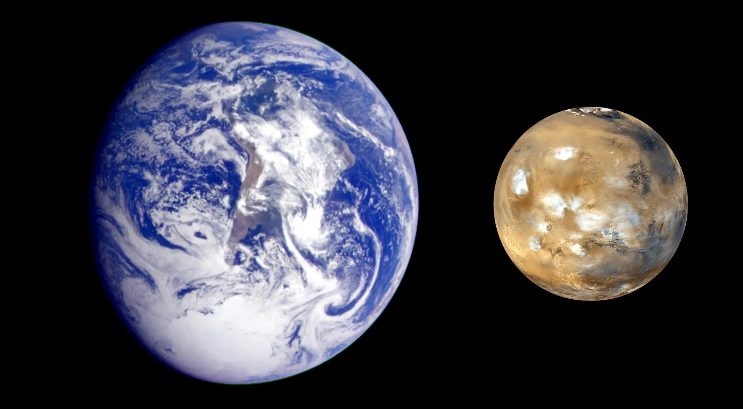
A new study has found that clocks on Mars run slightly faster than those on Earth, a difference researchers say could significantly influence future exploration and colonization efforts. Physicists Neil Ashby and Bijunath R. Patla reported that when transported to Mars, “Earthly clocks, when taken to the Red Planet, run 477 microseconds faster,” a shift linked to planetary gravity and motion.
According to the findings, the discrepancy stems from Mars’ weaker gravitational field, which aligns with general relativity theory suggesting that clocks advance more rapidly under reduced gravity. The researchers also incorporated the effects of the planet’s elliptical orbit and gravitational forces from elsewhere in the solar system, concluding that time on Mars can fluctuate by as much as ±226 microseconds per day.
See also: NASA Rover Spots Unusual Rock on Mars
While the measured difference may appear small, experts warn that the implications for future missions are considerable. Projects involving spacecraft navigation, communication systems and surface robotics depend on precise synchronization between Earth and Mars. Failure to adjust for time drift could result in miscalculations that affect mission safety and operational performance.
The study highlights parallels with Earth-based technologies, noting that modern 5G networks require synchronization accurate to one-tenth of a microsecond. Future Martian infrastructure—including autonomous rovers and GPS-style positioning systems—will need the same or higher standards to function reliably under the planet’s unique timing conditions.
See also: BepiColombo Prepares for 2026 Arrival at Mercury After Six flybys
Interest in Martian colonization has risen in recent years, particularly as billionaire Elon Musk continues to promote plans for long-term settlement on the planet. Researchers say that whether the goal is scientific exploration or building a permanent human presence, timekeeping adjustments will be an essential part of operating safely and efficiently on Mars.
Source: IOPscience