
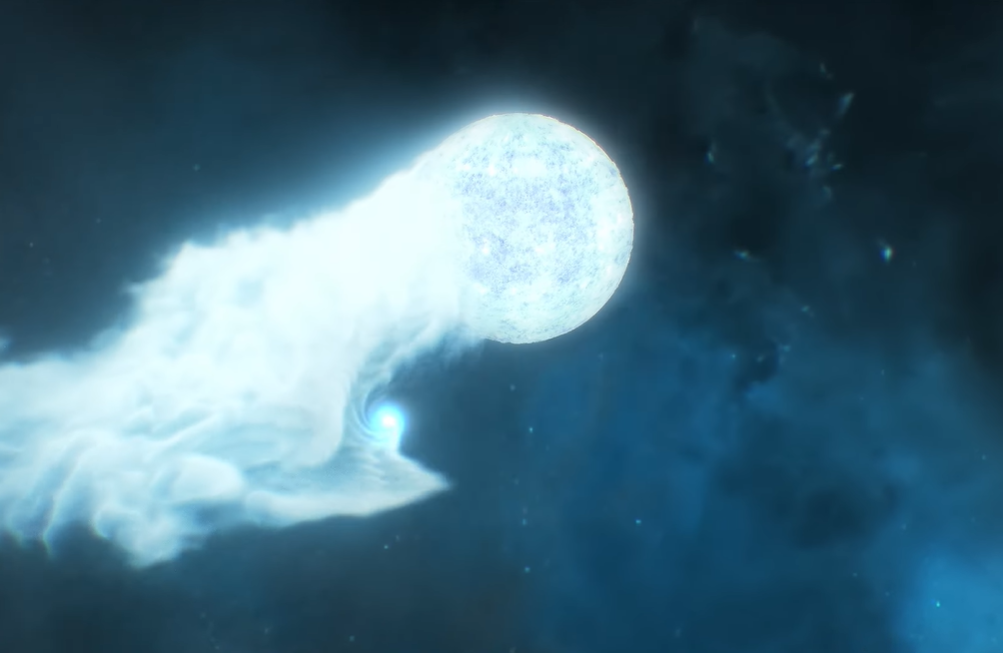
Astronomers have detected an unprecedented gamma-ray burst that lasted for at least seven hours, making it the longest such event ever observed and raising new questions about how extreme cosmic explosions are generated.
The event, known as GRB 250702B, was detected on July 2. Gamma-ray bursts are typically brief flashes of high-energy radiation linked to neutron star mergers or the collapse of massive stars into black holes. Most last seconds or minutes, and scientists have catalogued around 15,000 of them since the phenomenon was first identified in 1973.
Researchers believe the unusually long duration points to a black hole consuming a star, though the precise mechanism remains uncertain. One hypothesis suggests a rare intermediate-mass black hole, thousands of times more massive than the Sun, tore apart a star that ventured too close, sustaining the burst over several hours.
Another explanation involves a much smaller black hole orbiting a helium star, gradually drawing in gas before plunging into the star itself. Astronomers say the evidence does not yet favor one scenario over the other, and some observations complicate the picture, including the unusually large size of the host galaxy compared with those normally associated with gamma-ray bursts.
See also: Bennu Asteroid Samples Reveal Sugars, Ancient Material and Abundant Stardust
Scientists continue to analyze the data from GRB 250702B, whose total energy output was described as being equivalent to “a thousand Suns shining for 10 billion years,” underscoring the extreme scale of the event and its potential to reshape understanding of black hole–star interactions.