
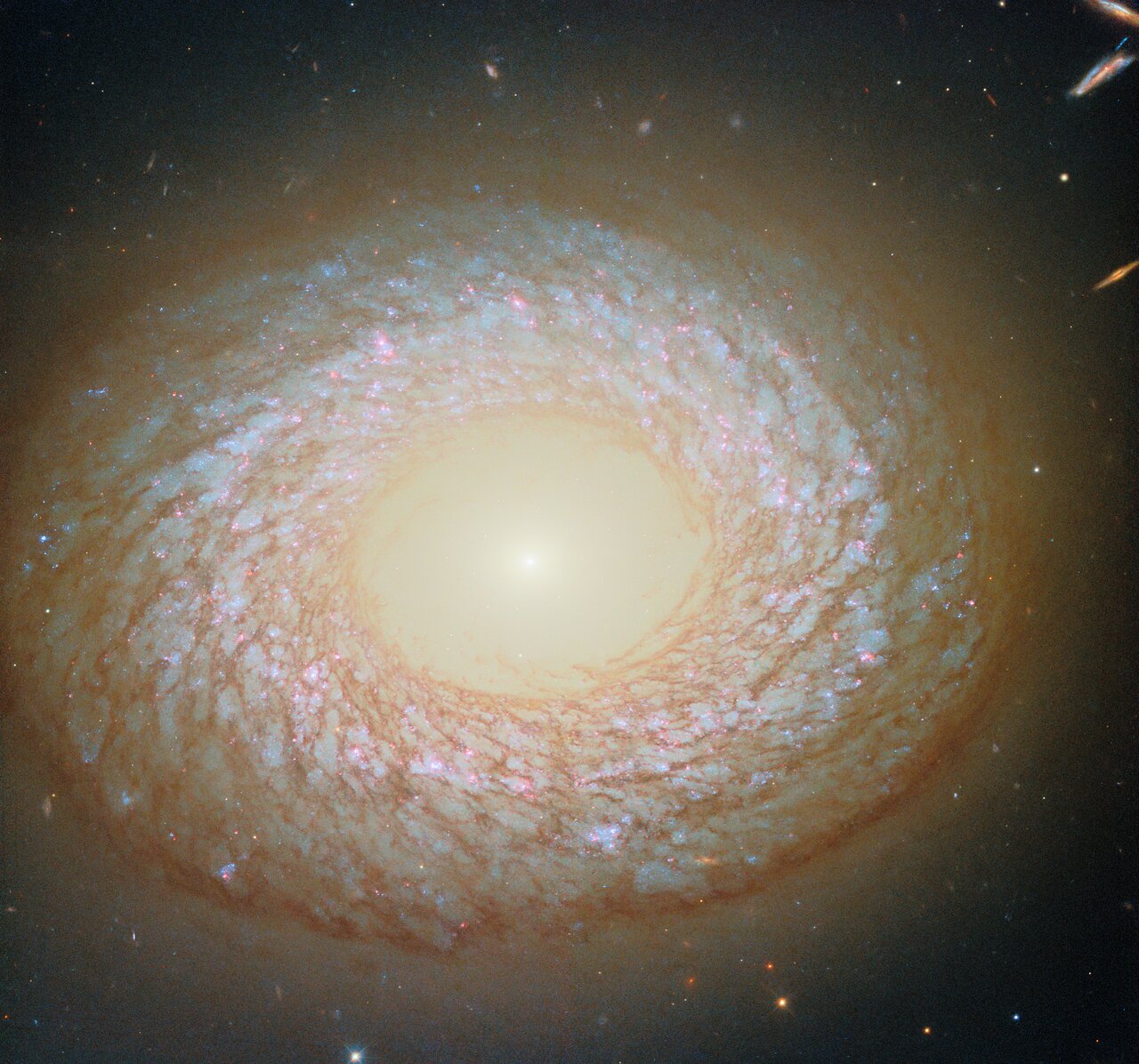
NASA’s Hubble Space Telescope has released a new image of galaxy NGC 2775, located 67 million light-years away in the constellation Cancer. The observation has reignited debate among astronomers about how the system should be classified.
At first glance, the galaxy’s smooth and seemingly clear central region resembles an elliptical galaxy. Yet the presence of a ring of dust containing patchy clusters of stars also gives it the appearance of a spiral system. “Is it a spiral galaxy, an elliptical galaxy, or neither?” the announcement asked, reflecting the uncertainty.
Some researchers have suggested NGC 2775 could be a lenticular galaxy, a type that displays features of both spirals and ellipticals. One theory holds that such galaxies may form when spiral systems merge with others. Earlier studies found a hydrogen gas tail stretching nearly 100,000 light-years around NGC 2775, a possible remnant of past mergers.
The new image includes data captured in H-alpha light, a wavelength that helps astronomers trace star-forming regions. This light is produced when young, massive stars emit ultraviolet radiation that ionizes surrounding hydrogen gas.
The Hubble view shows a bright central core surrounded by an inner dust ring, a thicker outer dust ring, and a swirling network of filaments in between. Blue stars and red nebulae shine through the dust, providing further clues to the galaxy’s complex structure and history.